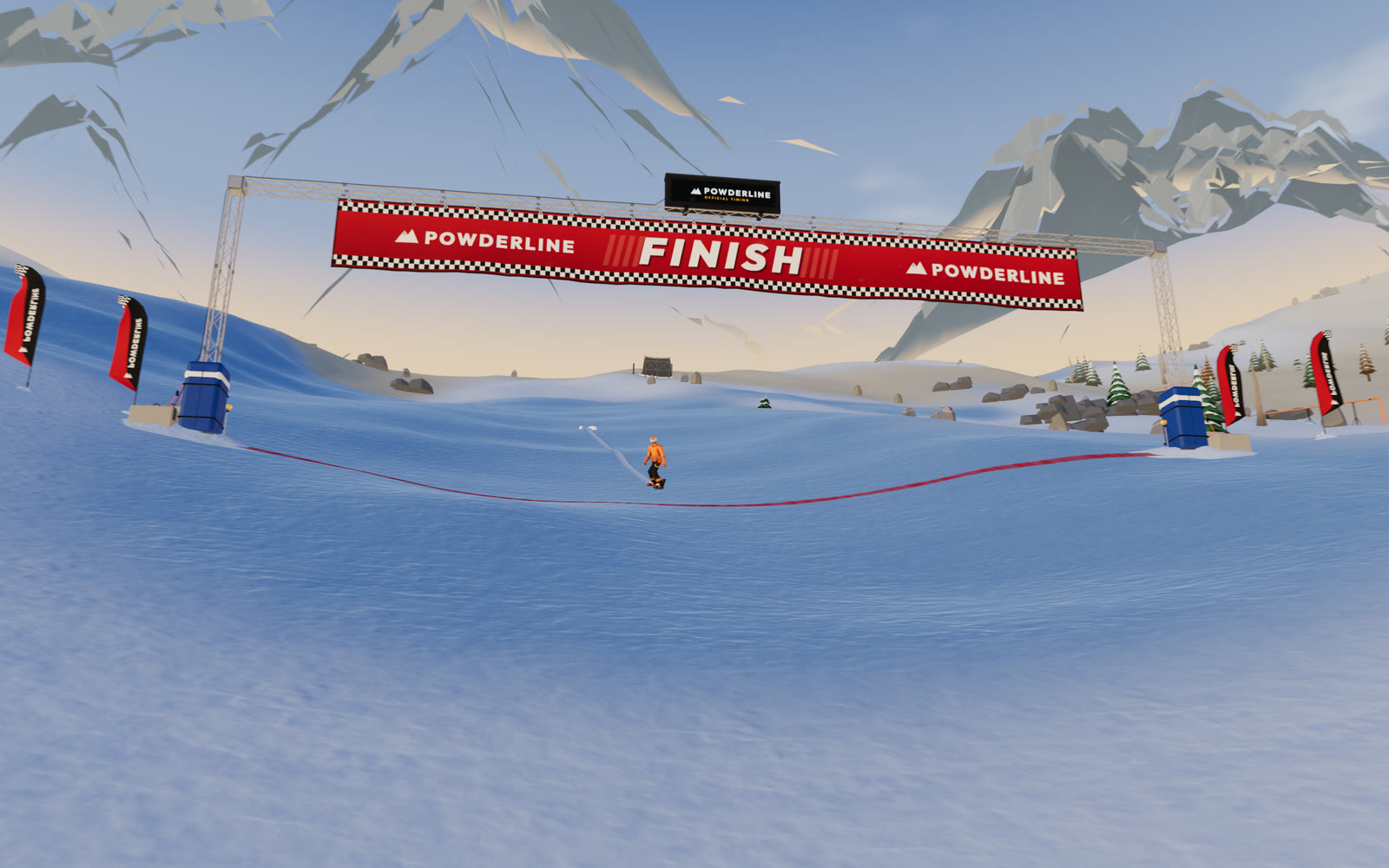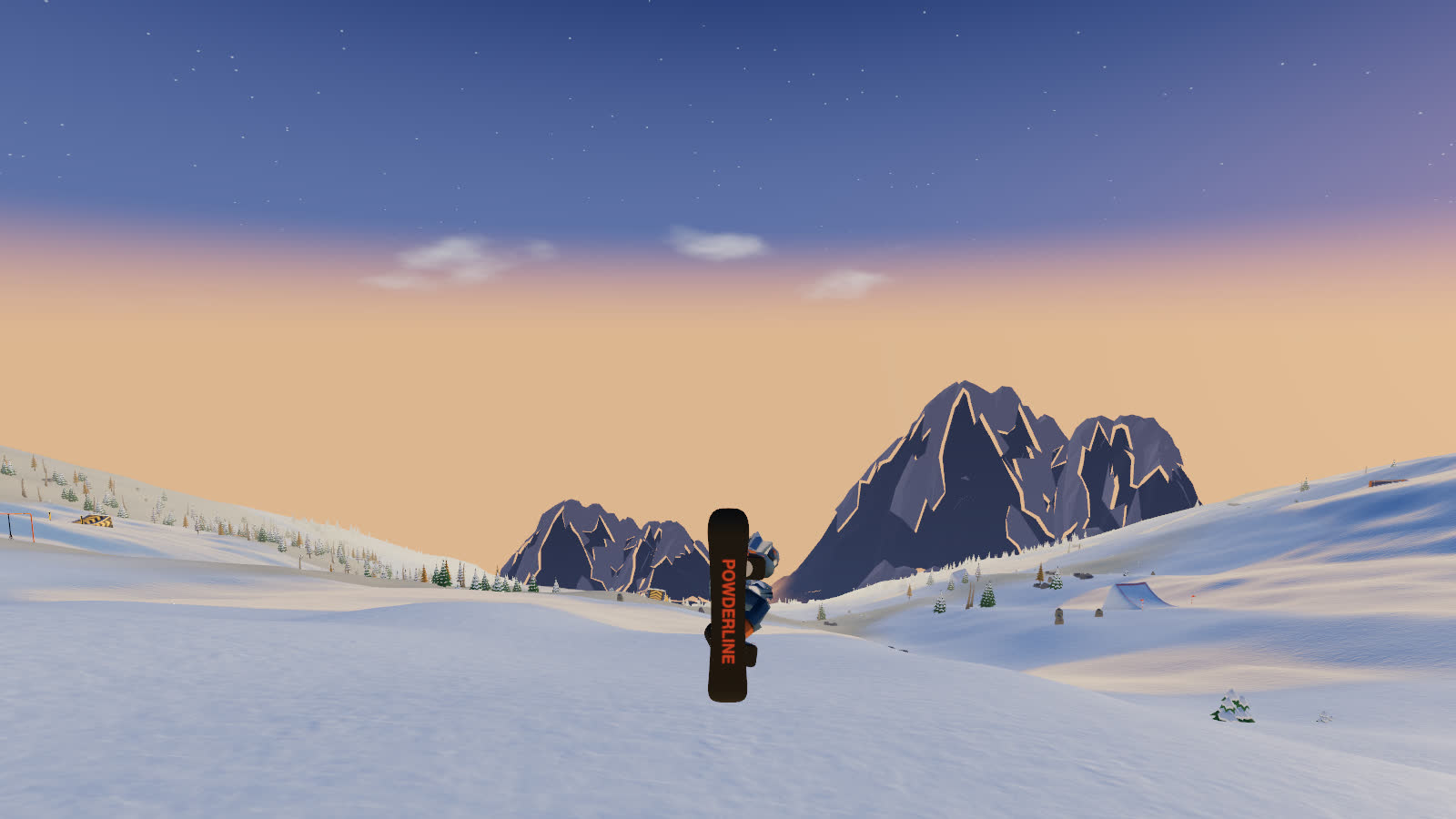
Ask anyone who has spent a week on a snowboard how they stop and they will show you the same move: the board swung across the slope and a spray of snow thrown out ahead. It is called a hockey stop, after the way ice-hockey players stop on their skates. Until this week, pressing S in Powderline slowed you down and that was all. Now it stops you the way a snowboarder actually stops.
How a real hockey stop works
A snowboard has two edges, one under your toes and one under your heels. To stop, you turn the board across your line of travel and tip it onto one edge, so it stops gliding and starts scraping. The edge that digs in has to be the uphill one; dig in the downhill edge and the board trips over it, the classic fall known as catching an edge. On a heelside stop you face down the hill and sit back over your heels. On a toeside stop you face up the hill and drive your knees into the slope. Either way the edge shears snow off the surface and throws it out ahead of you.
What S used to do
Before this update, holding S added a fixed amount of braking. The board kept pointing down the hill, the rider kept the same pose, and speed bled away until you crawled. Nothing on screen said why. It was also too weak on steep ice, where the slope pulled harder than the brake held: you could hold S down a frozen pitch and never stop.
How the game stops you now
The board swings across
Press S and the board turns across your line of travel at a set rate, a quarter turn in a fraction of a second. The braking is tied to how far round it has come: barely any while the board still points down the hill, full strength once it is across. So the stop builds from a slide into a scrape instead of slamming on. From about 50 km/h on the main slope it takes around two seconds and 13 metres of snow.
Heelside or toeside
By default you stop heelside, facing down the hill. If you were already turning toward your chest when you pressed S, the game carries the turn on round and you stop toeside, facing up the hill: a hockey stop is a turn taken past the fall line. Pressing the turn and S at the same moment counts.
The lean comes from the physics
The lean and the tilt of the board are not canned animations. Powderline already leans a rider into a carve by the force the edge is holding, and a stop uses the same rule: the scrape pushes back across the board, and that push is what the body leans against and what rolls the board onto its edge. A hard stop sits you well back on your heels; a gentle one barely tips you. Toeside, it mirrors.
Holding it, and letting go
Keep holding S and you stay parked on your edge across the slope, the way riders wait at the side of a run. Let go and the board swings back down the hill and you ride away in the stance you came in with. While you are stopping, the knees absorb far more of the slope's rollers, since a board lifted off the snow sideways at speed would land as a wipeout. In the air, S is still the backflip.
On ice
Ice barely takes an edge, so a stop on a frozen patch is a long slide, roughly twice the distance. The difference from before is that it ends: the edge now beats the pull of the steepest ice on the mountain. The snow guide has more on what each surface does.
The pose
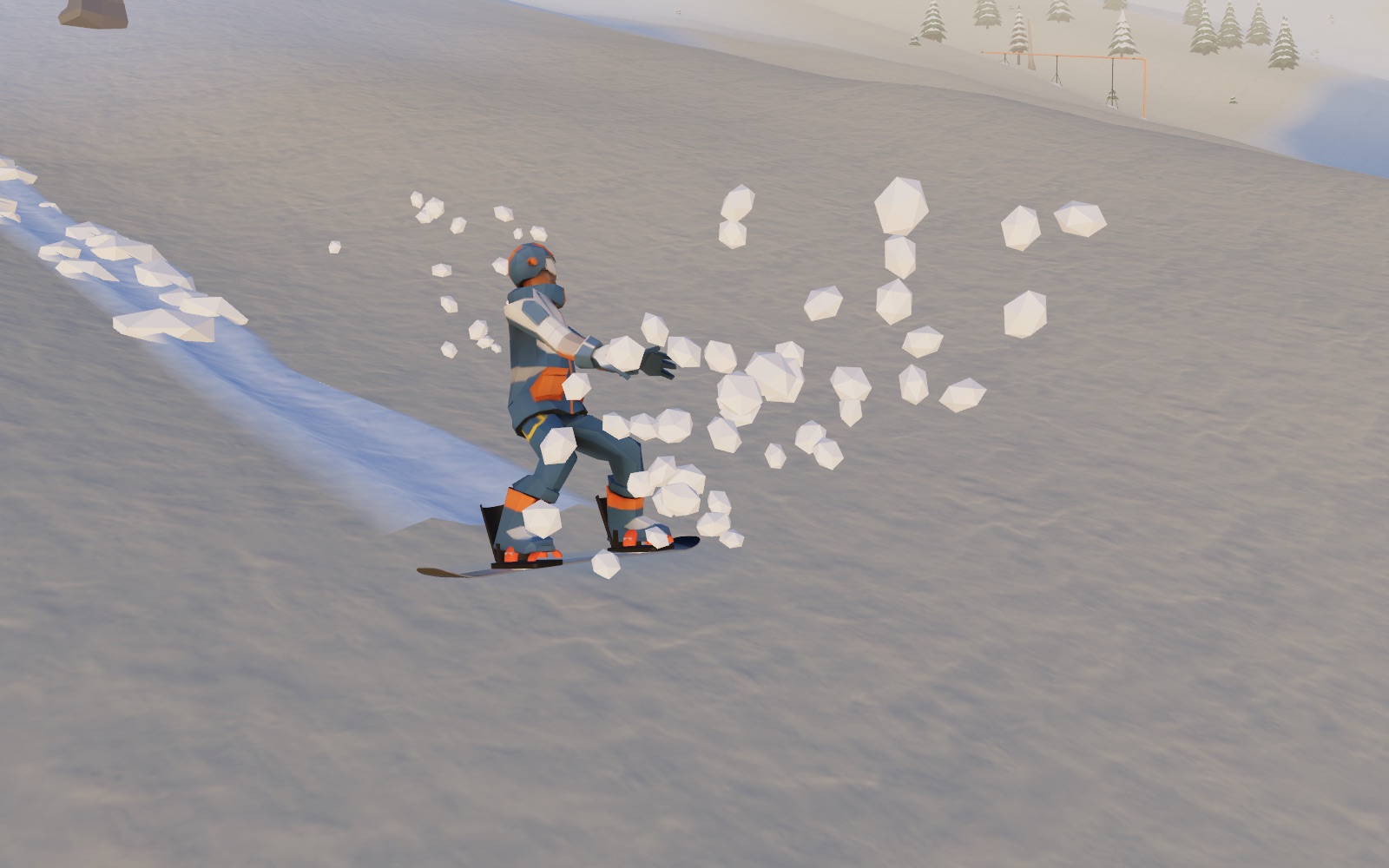
As the board comes across, the rider blends into a stopping stance: knees deep and a little wider, chest over the knees, both arms out in front as a counterweight, eyes on where the stop is going. The lean comes on top from the physics, so a hard stop and a soft one look different.
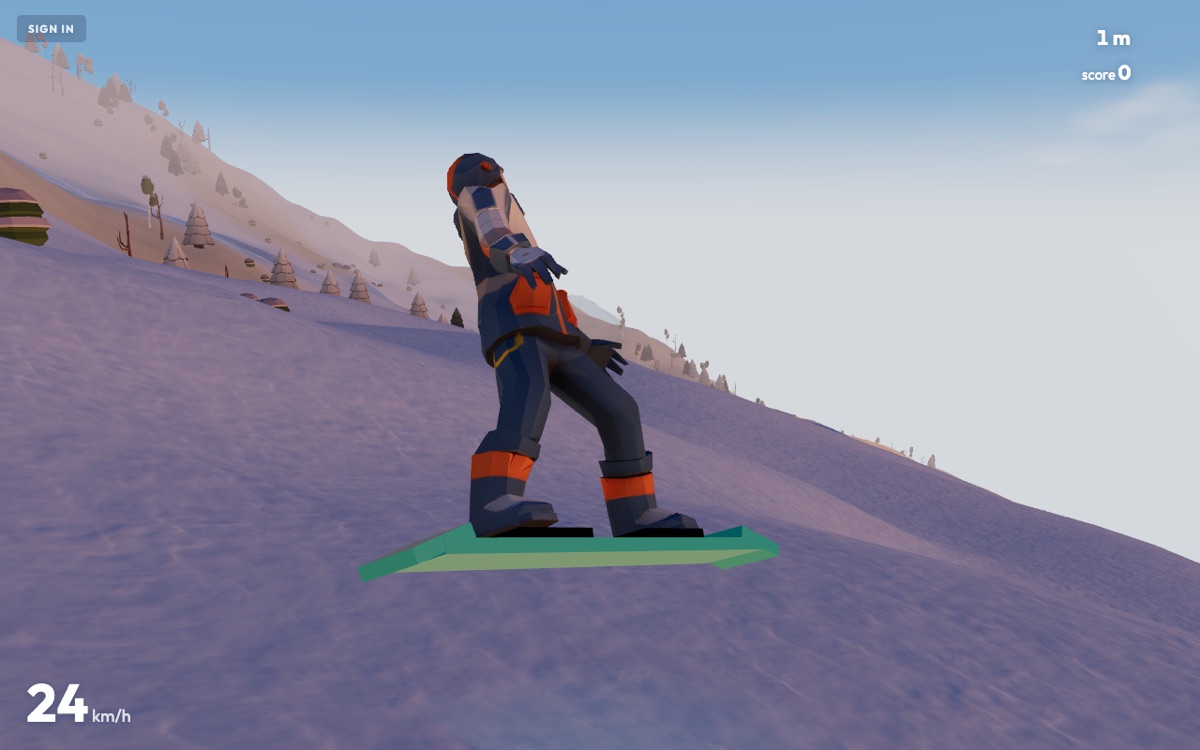
The spray, take two
The first spray was a cloud of soft powder billowing ahead of the board. From the chase camera it read as smoke, and it stalled so quickly that the rider slid straight into it.
The version that shipped uses the snow the game already throws. A hard carve flings lumps of snow off its slipping edge to the side; a stop throws exactly those lumps, same size, tumble and fall, shed along the whole edge and thrown ahead. They leave faster than the board is moving, so they land in front of you rather than around your legs. One look for snow coming off an edge, carving or stopping.
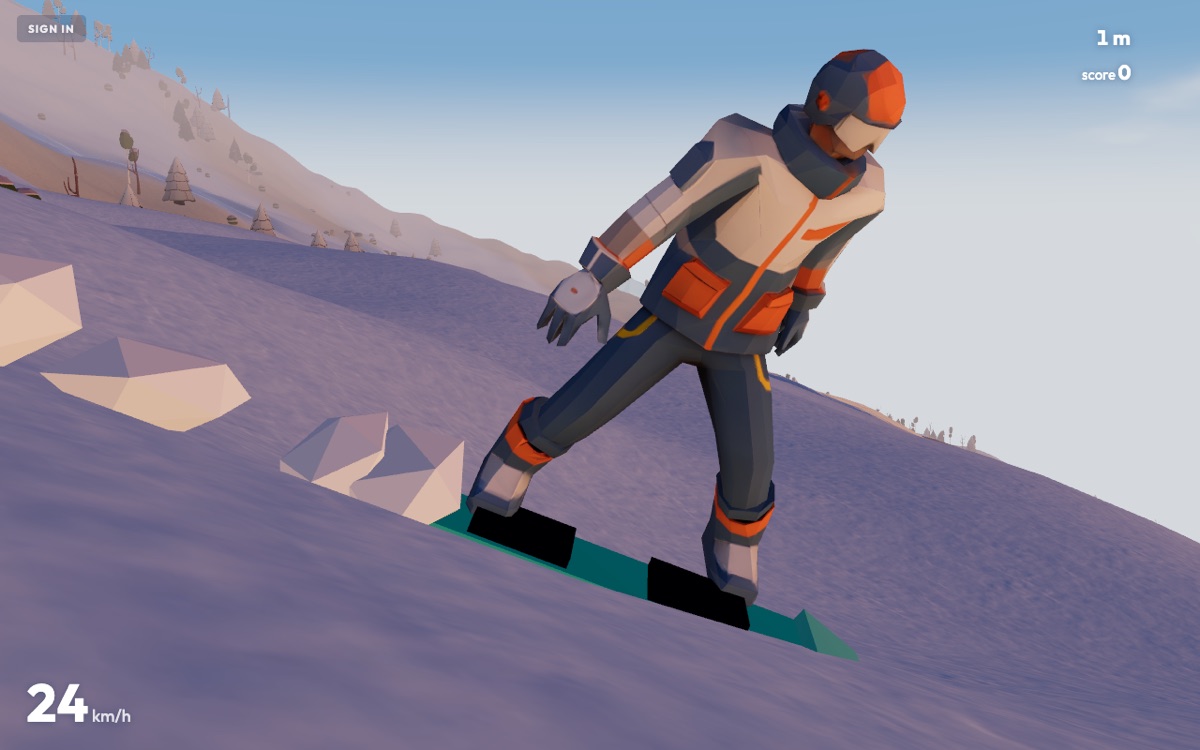
What the stop leaves behind
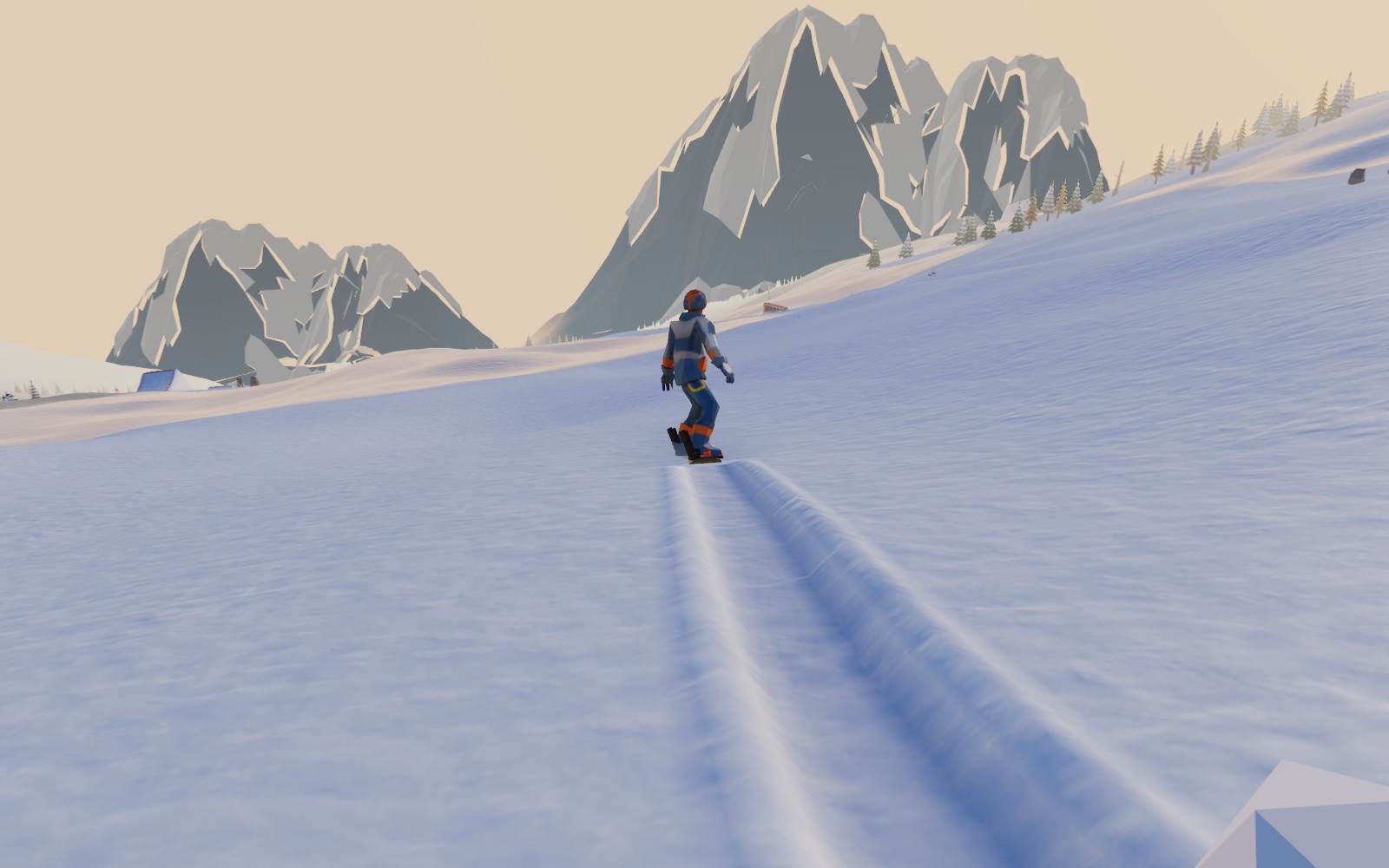
Swung across the slope, the board sweeps a much wider path than its usual groove, so the track widens into a scraped swath as wide as the board is long. Where you come to a stand, the snow the edge pushed ahead is left lying in a soft ridge on the slope. Look back up the hill and you can read the stop.
Sound, feel, and your rival
Under the crunch of the edge, a stop has its own broad, rough hiss that brightens the harder the edge bites. On a gamepad you feel the edge chatter as a rumble. In a 1v1 race your rival's stops show on your screen too, pose and spray included; how two browsers keep each other's riders in step is in Racing a friend down an endless mountain.
How it was tested
The physics has tests that ride a simulated slope and check what a player would notice: a heelside stop brings you to a stand within a set time and distance, with the board across and the rider on the heel edge; turning first gives the toe edge; a held stop stays parked; letting go rides away in your stance; ice stops you over a longer distance; S in the air stays the backflip; and the stop pose keeps both boots on the board.
Then it was looked at: filmed from the chase camera, the front, the side and up close on the edge, on both of the game's renderers, WebGPU and WebGL. That is how the smoky powder was caught, and how a bug in the 3D engine came to light that kept the spray from appearing at all on some machines. It affected the trees too; Drawing a forest for less tells that story.
Try it
Get some speed, press S, and watch the snow fly; turn with D first to stop on your toes. The keys are on the controls page, the change is in the changelog, and the rest of the week is in A week on the mountain.