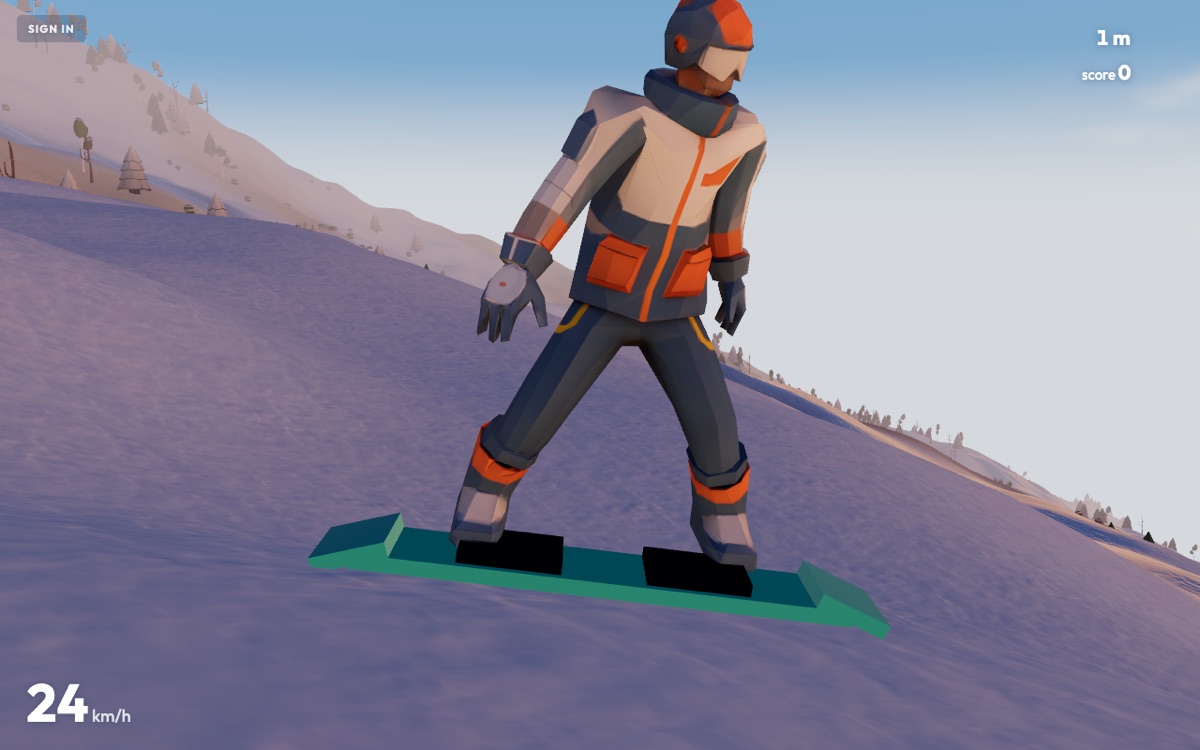
The basics
Powderline is an endless descent. You start at the top of a procedural alpine slope that never repeats and never ends; the run is over when you wipe out. Two numbers matter: distance — how far down the mountain you got — and score, which comes from tricks. Your best of each is kept on your profile and, if you post it, on the leaderboard.
Nothing needs installing. The whole game is about 2 MB and runs in any modern browser, on a laptop with integrated graphics or on a phone in landscape. An account is optional: it saves runs, coins and cosmetics across devices and unlocks quests, the wheel and the closet.
Controls
Keyboard
| KEY | ON SNOW | IN THE AIR |
|---|---|---|
| A / D | carve left / right | spin |
| W | tuck for speed | frontflip |
| S | hockey stop | backflip |
| SPACE | jump — also pops you off a rail | — |
| SHIFT | ride faster | grab |
| T · M · P | time of day · mute · pause (ESC also pauses) | |
| L · K · N | radio on or off · station (lofi or deep house) · next track | |
| R | reset — picks you up where you fell | |
Controller
Plug in any standard gamepad and it just works. The left stick or d-pad carves (spins in the air) — it is analog, half a deflection is half a carve; RT tucks and LT brakes (front and back flip in the air; the stick's vertical does the same); A jumps and drops you back in; X, RB or B is SHIFT — ride faster, grab in the air; Start pauses, Y cycles the time of day, Back resets. Landings, boosts and wipeouts come through the rumble.
Phone
On a touch screen the left half of the screen is a floating steering pad: drag sideways to carve (spin in the air), drag up or down past the dead zone to tuck or brake (front or back flip in the air). JUMP is a tap; BOOST is a hold — it rides faster on snow and turns into GRAB while you are airborne. When you wipe out, tap anywhere on the wipeout card to drop back in.
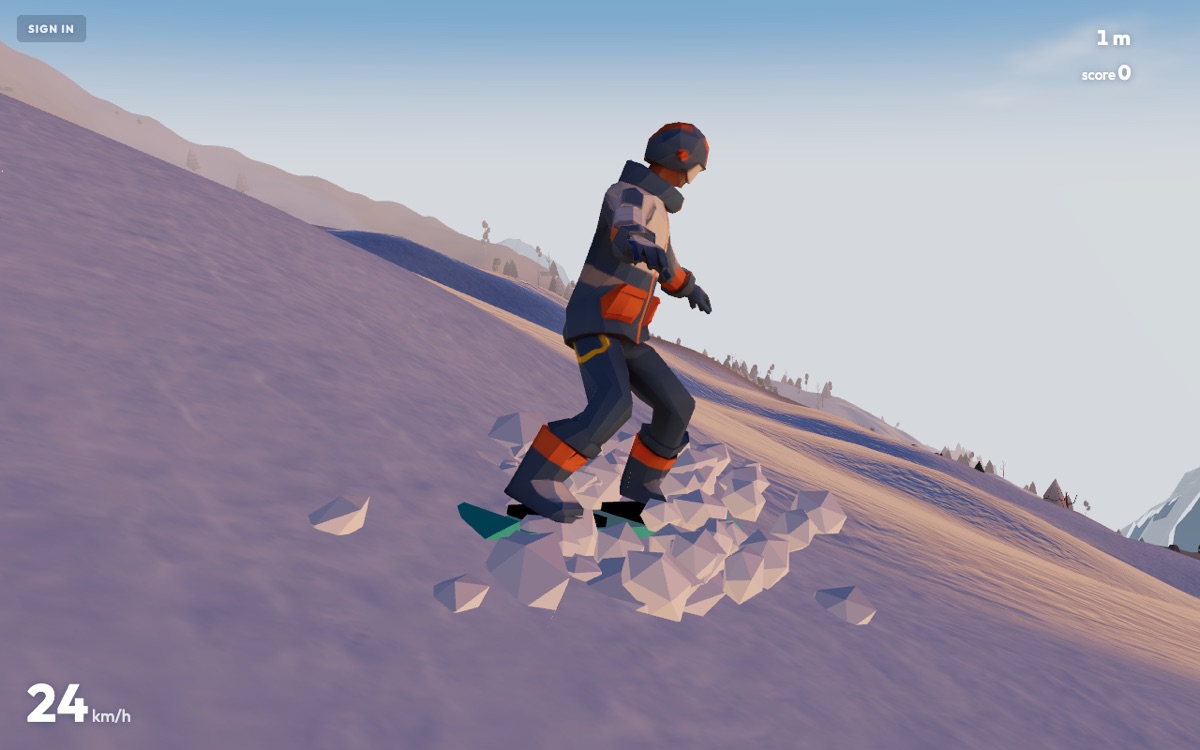
Riding
The physics are tuned toward real snowboarding rather than arcade numbers. Upright you settle around 68 km/h; tucked (W) drag drops and you reach roughly 95 km/h; holding SHIFT pushes toward the hard cap of 130 km/h. Deeper down the snow runs faster: a tuck settles near 105 km/h four kilometres down and near 110 km/h past ten. A carve at speed sweeps a wide arc — about a 40 m radius at 70 km/h — so line choice starts a long way before the obstacle.
The rider moves like a rider. A steer key rolls the board onto its edge over about a tenth of a second rather than snapping to full lock, and the body leans with how hard the carve pulls — well over at speed, barely tilted at a crawl — with the head turned into the turn. A jump is a push: the legs drive straight off the snow before the knees draw up. In the air a flip pulls the body into a tight tuck, a spin winds the shoulders ahead of the board and lets them unwind as it brakes, and the eyes drop to spot the landing. The camera stays calm through all of it: it opens up a little on a real air and dips slightly with your knees on a landing, nothing more.
Ice is glossy, fast and low on grip: you slide wide and brake badly. Deep powder is the opposite — slow, forgiving on landings, and it throws a wake behind the board. Mogul fields unweight you: hit them fast and the bumps become small, uncontrolled airs. Trees are solid, including mid-air; frozen patches stay open because nothing grows through ice.
Kickers and rails spawn near the main corridor of the slope so they are findable. A kicker is a deliberate launch: ride on at the entry and straight up its lip for real air. Its sides and lip face are solid — come at one from the flank and you hit it. A rail is a rigid straight tube about 16 metres long that slopes with the hill — ride into it to grind, steer to stay balanced, and hit SPACE to pop off when you have had enough.
The mountain deepens
Difficulty is a property of the mountain, not of your run: it ramps with absolute descent, easing in between 300 m and 4 km below the start. Deeper means bigger rollers and undulations, wider and taller mogul fields, denser rocks and tighter trees, and more ice. The pace keeps climbing after that, all the way to 10 km: the snow runs faster, and landings forgive less, with a narrower window for a clean stomp and less help levelling the board. The first kilometre teaches the controls; the fourth is a different sport. Because the terrain is deterministic, two players in a race see the identical mountain.
The mountain in regions
On top of that curve the descent is cut into regions, each a few hundred metres to a kilometre long, and a banner names each one as you cross into it. OPEN SLOPES is the baseline, and always the first. DEEP WOODS closes the trees in. The BOULDER FIELD is rocks to weave through or hop. The SNOW PARK puts a kicker or a rail on nearly every stretch. The ALPINE BOWL is wide, bare and fast. On THE PISTE other riders stand about with their boards — they are as solid as a tree and they do not step aside. Others hike up the hill, boards on their backs, and they do not step aside either. The sequence of regions is part of the mountain, the same for everyone.
Tricks and scoring
In the air, flips and spins integrate off-axis: holding a flip and a spin at the same time does not add two tricks, it carves out a misty, a rodeo or a cork depending on the mix. Rotation spools up as you hold the key and is braked when you release — momentum carries you about a tenth of a turn past the release (more with a grab on), so a rotation has to be stopped, not just let go. Flips wind up to about 400°/s and spins to about 300°/s: a single flip or a 360 fits a kicker air at cruising speed, anything more wants a grab and more speed.
A grab (SHIFT held for at least a quarter second) pulls the body in, so you rotate half as fast again. The grab is the key to the multi-flip tiers, and the risk that pays for the points: a grabbed flip commits you to more rotation, and you must open up in time to stop it.
The trick book
A trick is credited in whole steps — a flip per full turn, a spin per 180° — and a step counts only once you have come within the landing window of completing it: about 57° for a flip, 63° for a spin. Short of that it is the step below, never the nearest one. 250° of yaw is a 180 landed long, half a backflip is no backflip at all, and what the popup names is exactly what came down. Every rotation has one name:
| ROTATION | NAME | FITS |
|---|---|---|
| one flip | FRONTFLIP / BACKFLIP | a kicker at cruising speed, no grab needed |
| two to five flips | DOUBLE / TRIPLE / QUAD / QUINT + the flip | grabbed: a double from about 58 km/h into the kicker, a triple from about 94 km/h, a quad only off a top-speed hit — a quint fits no air on this mountain |
| spins, in 180° steps | FS / BS 180, 360, 540, 720, 900, 1080… | a 360 on a kicker; 540 and up want a grab or bigger air |
| one flip with spin | MISTY (forward) / RODEO (backward) + degrees | as the flip |
| two or more flips with spin | FS / BS DOUBLE, TRIPLE, QUAD CORK + degrees | as the flips |
| grabs | MUTE | SHIFT held a quarter second in the air. The leading hand takes the toe edge between the bindings — straight, spun or flipped — and that is the name it lands with |
| modifiers | SWITCH in front · the grab behind | taken off riding switch · e.g. SWITCH BS 540 MUTE |
What a trick is worth
| ELEMENT | POINTS |
|---|---|
| Air time | after 0.55 s in the air: (air time in seconds)² × 40, rounded — 1.5 s of air is 90 points, 3 s is 360 |
| Spin | 1.5 points per degree from 180° up — a 360 is 540, a 720 is 1080 |
| Flip | 450 per full flip |
| Grab | 150 per second held |
| Switch takeoff | × 1.25 on any trick launched riding switch |
| Repeat | the same trick twice in a row pays half — variety is the whole game |
| Combo | a multiplier that grows while you keep landing clean, and resets on a sketchy landing or a wipeout |
Landings are graded
How the board meets the snow decides what the trick was worth. Four bands:
- Perfect stomp — board within about 13° of the slope and 20° of the line: points × 1.15, combo grows, and the full speed payout.
- Clean — within about 34° of the slope and 46° of the line (a little more in powder): full points, combo grows, a speed payout scaled by how level you were.
- Sketchy — up to about 57° of tilt or 63° across the line, and only if you are still carrying speed: you stay up, but the trick pays 40 %, the combo is gone and there is no speed boost.
- Beyond that — or coming down mid-rotation — is a wipeout. The sketchy limit is the trick book's crediting window: a rotation either comes down as the trick, or it does not come down at all.
A stomp assist arms three tenths of a second before touchdown and settles about half of whatever tilt is left, but only inside 43°: it tidies a rotation you finished, it never finishes one for you. Every scored trick also pays out speed: up to 7.5 m/s (27 km/h) added to your velocity in proportion to the points, and in full only when the landing was perfect. Chaining tricks is how you outrun the mountain.
Quests and coins
Coins are the game's only currency and are earned by clearing quests (or bought as coin packs in the shop). Signed-in riders get a fresh set of daily quests each day and weekly quests each week, drawn from the templates below with a randomised target and reward inside the range shown. Progress is measured from your ride log automatically; claim a completed quest on the account screen to bank the coins.
| DAILY | TARGET | COINS |
|---|---|---|
| Ride a distance in a single run | 800 – 2 400 m | 8 – 14 |
| Cover a distance today | 3 000 – 6 000 m | 10 – 15 |
| Hit a top speed | 95 – 115 km/h | 8 – 12 |
| Land flips | 3 – 8 | 8 – 14 |
| Grind rails | 40 – 120 m | 8 – 14 |
| Score in a single run | 1 500 – 4 000 | 10 – 15 |
| Finish runs | 3 – 6 | 8 – 12 |
| Land spins of 540° or more | 1 – 3 | 10 – 15 |
| WEEKLY | TARGET | COINS |
|---|---|---|
| Cover a distance this week | 15 – 30 km | 45 – 70 |
| Land flips this week | 20 – 40 | 40 – 60 |
| Total score this week | 10 000 – 25 000 | 45 – 65 |
| Grind this week | 300 – 800 m | 40 – 60 |
| Finish runs this week | 15 – 30 | 40 – 60 |
| Win 1v1 races | 2 – 5 | 50 – 70 |
| Finish runs past 1 km | 3 – 8 | 45 – 65 |
There is one more faucet: invites. Share your invite link from the account screen and when a friend signs up through it, both of you receive 200 coins — for up to twenty recruits.
The wheel and the closet
The shop's prize wheel turns coins into cosmetics. A spin costs 75 coins; the odds are published in the shop and are the same for everyone:
| RARITY | CHANCE | ITEMS |
|---|---|---|
| Common | 55 % | 15 |
| Uncommon | 25 % | 21 |
| Rare | 13 % | 18 |
| Epic | 5.5 % | 11 |
| Legendary | 1.5 % | 5 |
A pity timer guarantees a legendary within 60 spins, and spinning an item you already own refunds part of the cost in coins. The seventy items cover five slots — tops, pants, hats, boards and particle trails — and the closet is a 3D fitting room where you can try any combination on a mannequin before you wear it. Cosmetics are purely visual; nothing on the wheel changes how the board rides.
Coins and items are a licence to use them in the game. They cannot be traded or cashed out, and drop odds may be rebalanced — see the terms.
Racing friends
A 1v1 race connects two browsers directly, peer to peer: start a race, send the invite link, and your friend drops into your lobby. Every race is on a new course, a fresh stretch of the mountain that both of you get identical. After a synced countdown you both ride the same corridor and the first through the finish gate wins; the host picks the race length. In trick battle mode there is no finish line — the clock is the gate, and the higher score when time runs out takes it. Crashes cost you time, not the race: you respawn and keep going, and in a battle your banked points survive the fall. A rematch is one click.
The account screen
Sign in with an e-mail address or a Google account. The account screen holds your coins, quests, ride log, best distance and score, an activity heatmap with your day streak, and your invite link. Rider names are unique, so pick one and it is yours. The leaderboard has day, week, month and all-time boards. Found a bug or have an idea? Feedback & bugs in the menu footer sends it straight to the mountain patrol, screenshots included — a report that leads to a fix earns 200 coins.
Five tips from the patrol
- Stop your rotation early. Momentum carries you about a tenth of a turn past the release, more with a grab on. Let go before you are level, not when — the assist only tidies the last few degrees.
- Vary the tricks. The same trick twice pays half. Alternate flips, spins and grabs, and switch your takeoff stance for the 1.25×.
- Stomp for speed. A perfect landing on a big trick adds up to 27 km/h. Deep in the mountain that speed is what carries you over the next mogul field.
- Read the surface. Blue-grey gloss is ice — set up the turn early. Soft pillowy snow is powder — it forgives an ugly landing.
- Use the time of day. T cycles midday, golden hour, dusk, night and dawn. Night hides the rocks; midday shows every bump.
Go deeper
This page is the overview. Each of these takes one system apart with the actual numbers the game runs on:
- The trick book and how it scores — every rotation the game can name, the windows that credit them, and the exact arithmetic behind the points.
- Landings: stomp, clean, sketchy, wipeout — the four bands, the angles between them, and what the stomp assist does and does not do.
- Ice, powder and hardpack — what each surface does to grip, drag, braking and landings, and where you find them.
- How the mountain is built — the layers of the procedural slope, why it never repeats, and exactly what gets harder as you descend.
- Kickers and rails — kicker geometry and the one way onto it, how a rail catches you, and how a grind pays.
- 1v1 races — how a peer-to-peer race works: the link, the countdown, the finish gate, and what a crash costs.
- Controls and settings — keyboard, controller and touch in full, and what the quality watchdog is doing.
- Gear, the wheel and quests — the seventy cosmetics, how rarities are rolled, and what a quest actually checks.
- Under the hood — WebGPU with a WebGL2 fallback, deterministic terrain, snow that remembers, and a backend that trusts nobody.
Your first run starts in seconds
Free in your browser on a laptop, a phone or a gamepad. No download, no sign-up.
PLAY FREE