One function, no map
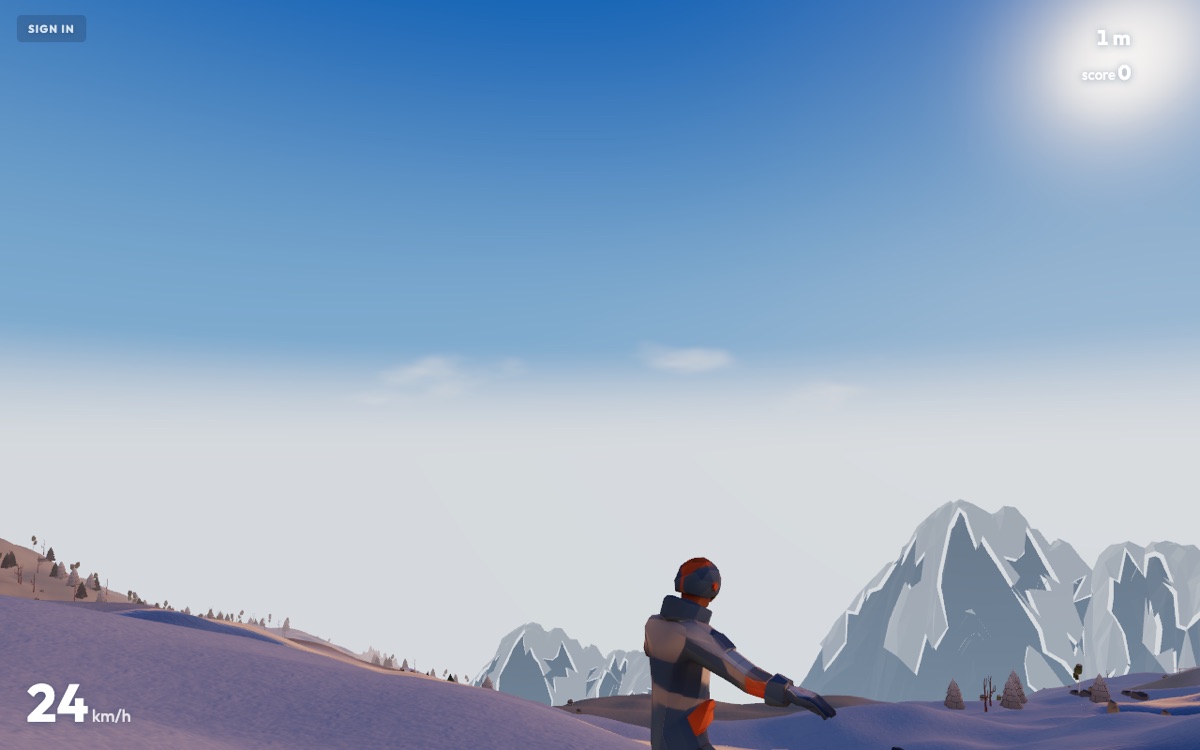
There is no level file. The height of the snow at any point is a single function of its coordinates, evaluated on demand, and the world is streamed in 80-metre chunks around the rider — nine ahead, three to each side, one behind — built as you approach and dropped as you pass. The mountain is endless because the function is. It never repeats because the noise under it does not.
That function is deterministic. Ask for the height at the same coordinates on any machine and you get the identical number, down to the last bit, which is what makes peer-to-peer racing possible: two browsers build the same mountain independently and only ever need to tell each other where the riders are.
The layers
The slope averages 23° — the grade a real black run sits at. On top of that base pitch the height is built from stacked layers of noise, each with its own scale:
| LAYER | SCALE | SIZE |
|---|---|---|
| rollers | hundreds of metres | ±23 m — the big swells that unweight you at speed |
| undulation | tens of metres | ±4.5 m near the top, ±6.5 m deep |
| moguls | metres | ±0.85 m, amplified up to nearly three times inside mogul fields |
| powder pillows | metres | ±0.15 m of soft relief, only inside powder zones |
| the valley | the whole width | a funnel rising 18 m by 150 m either side of the corridor, so the run has a middle |
Mogul fields are their own noise band: outside one the bumps are gentle, inside one they grow into the small uncontrolled airs that the guide warns about. Hit a field fast and the board leaves the snow every crest.
What deepens
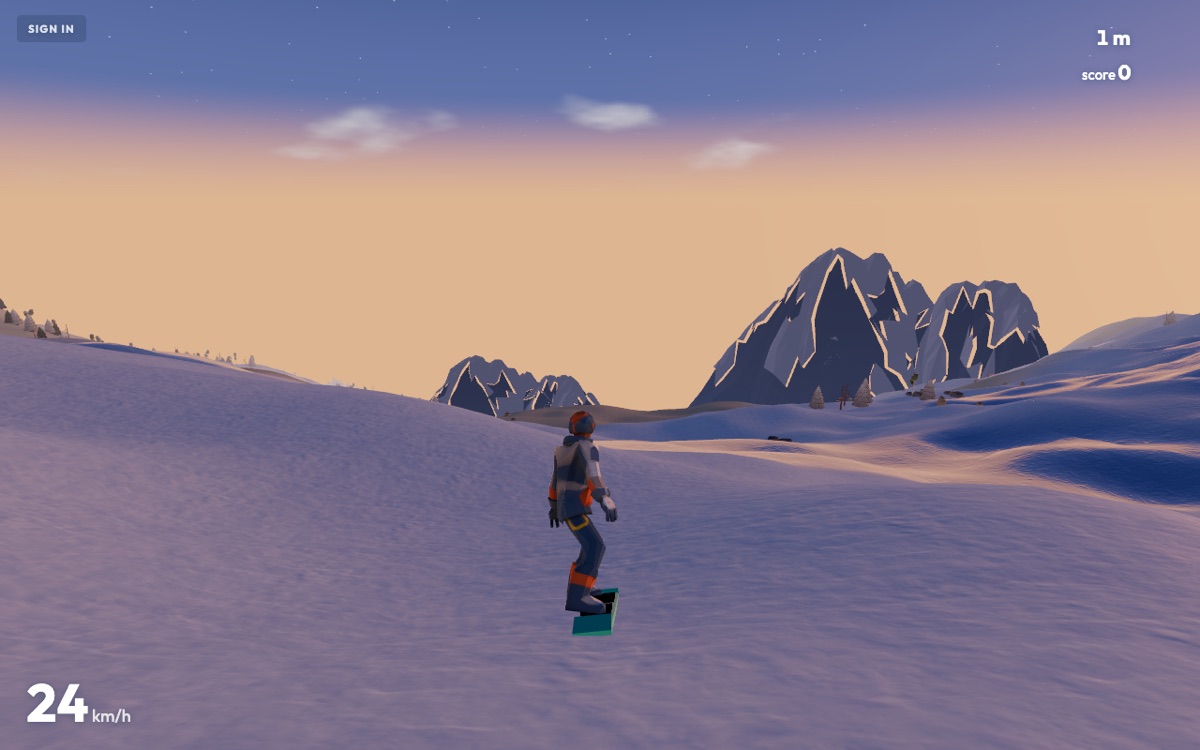
Difficulty is a property of the mountain, not of your run. It ramps with absolute descent, easing in between 300 m and 4 km below the start on a smooth curve — and because chunks persist across respawns and both racers derive the same world, nothing about it depends on how you got there. The first kilometre teaches the controls. The fourth is a different sport, and it keeps getting faster after that.
- Rougher ground. Undulation grows from ±4.5 m to ±6.5 m, mogul fields widen and their bumps grow by half again.
- More ice. The threshold for a frozen patch eases, taking ice from roughly 29% of the ground to 49% (see surfaces).
- Denser woods. The bar a tree or rock has to clear to grow drops steadily with depth, so four kilometres down the woods stand markedly thicker than at the top.
- Faster snow. From 200 m down, the snow runs a little faster with every kilometre: a tuck settles near 95 km/h at the top, 105 km/h at 4 km and 110 km/h past 10 km. This part keeps climbing after the terrain stops getting rougher.
- Stricter landings. Over the same curve the window for a clean or perfect stomp narrows by about a fifth, and the assist that eases a finished rotation level weakens by more than a third. What counts as a wipeout never moves.
- More park. The roll that places a kicker near the corridor rises from 40% to 46% per chunk, and a rail from 32% to 40%, because the rougher ground rejects more sites and the park has to stay findable.
The regions
Over the depth curve the descent is cut into regions: bands along the fall line, each 550 to 1000 m long, drawn from the same hash as everything else so the sequence is part of the mountain. A region never repeats back to back, and the first is always OPEN SLOPES. A region does not change the ground — the height field, the ice and the powder are what they are — it re-weights what stands on it.
- OPEN SLOPES. The baseline mix: the mountain as it was.
- DEEP WOODS. The forest threshold drops and the woods pack about twice the trees per chunk; fewer rocks, fewer kickers.
- BOULDER FIELD. Rocks scatter about five times thicker and a third larger, trees thin out, and nobody stands about in it.
- SNOW PARK. The kicker and rail rolls are scaled up and a chunk rolls twice, so nearly every stretch has something to hit.
- ALPINE BOWL. Wide and nearly bare: a breather between the hard ones, and the fastest ground on the hill.
- THE PISTE. Groomed, sparse, and busy: about one standing rider per corridor chunk, some in pairs, on flat snow clear of the trees and the park. They collide like trees.
Hikers walk through most regions too — a 72 m line up the fall line inside a chunk, chosen where the scatter could put neither a tree nor a rock. A hiker climbs at 1.1 m/s, rests two seconds, walks back down at 1.5 m/s, rests, and climbs again; its place at any moment is a function of the path and the mountain's clock, so nothing about it depends on the client.
What lives on it
Trees, rocks and bushes are scattered per chunk from the same seed, never on ice, never in the takeoff path of a kicker or the run-in to a rail. A pine collides as a thin trunk with a wide canopy above: you can ride right past the trunk, and an airborne rider clips the canopy exactly where it looks solid. Rocks are low enough to jump. Kickers and rails spawn only near the main corridor and only where the ground is flat enough to ride onto cleanly, which is why they are rarer where the mountain is rougher — and why the odds are nudged up to compensate.
From about 900 m down, gondola lifts run beside the run: a glass terminal at the top, a line of steel towers carrying the rope over the trees, cabins riding it down one side, round the bullwheel in the bottom terminal and back up the other, a kilometre or two of it, then open mountain until the next line. A clearing is cut through the woods under each line. The towers and stations are as solid as a tree; the ropes and the cabins are overhead and never in your way. Where a line runs is part of the mountain, the same for everyone, and the cabins keep the same clock in a race.
Your first run starts in seconds
Free in your browser on a laptop, a phone or a gamepad. No download, no sign-up.
PLAY FREE