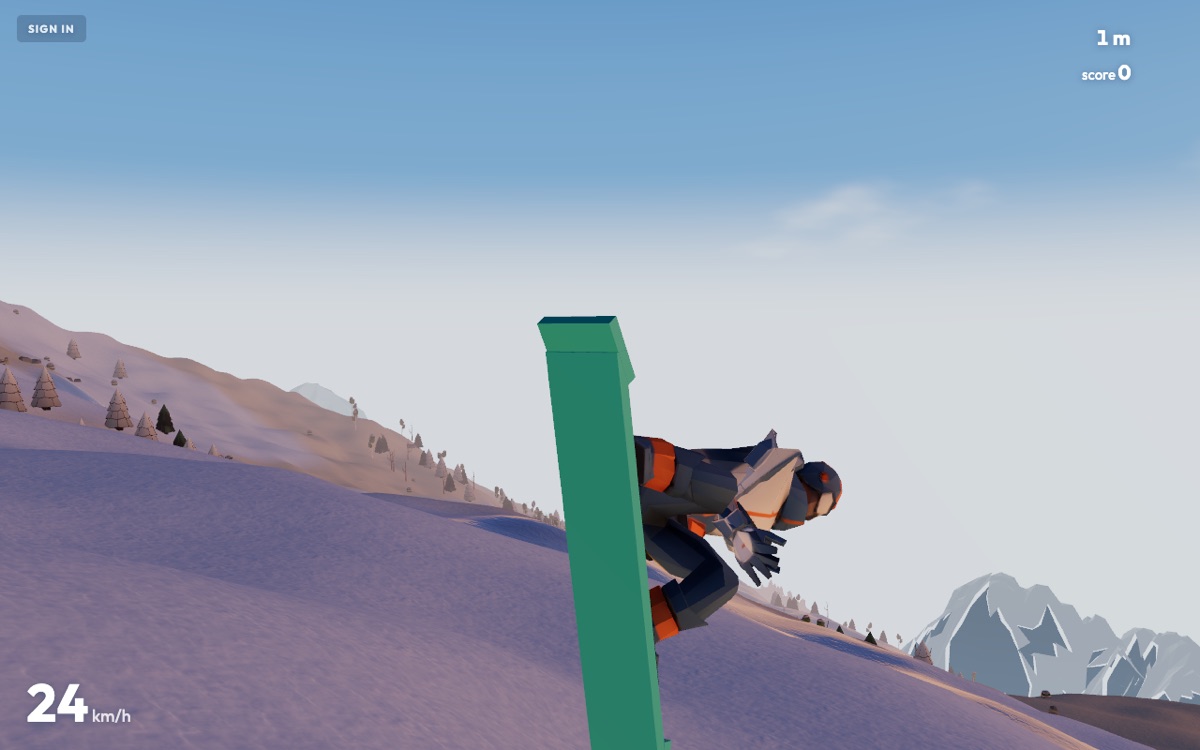
How a trick is read
Powderline does not ask which trick you meant. It reads the rotation you actually brought down and names it. A trick is credited in whole steps — one flip per full turn of pitch, one spin step per 180° of yaw — and a step only counts once you have come within the landing window of completing it: about 57° for a flip, about 63° for a spin. Anything short of that is the step below, never the nearest one. A 250° spin is a 180 landed long. Half a backflip is not a backflip; it is a wipeout.
Those two numbers are the same ones the landing uses to decide whether you survived (see landings), which is deliberate: what the popup names is exactly what came down rideable. There is no third state where an unfinished flip lands on its feet and gets a name anyway.
Flips and spins are integrated off-axis. Holding a flip and a spin together does not stack two tricks — it carves out one rotation with both components, and the name comes from the mix. Rotation spools up while you hold the key and is braked when you let go; the body's momentum carries you about a tenth of a turn past the release, more with a grab on, so a rotation has to be stopped, not just released. Flips wind up to roughly 400°/s and spins to roughly 300°/s.
The vocabulary
Every rotation the physics can produce has one name. Nothing is rounded into a neighbour.
| ROTATION | NAME | NOTES |
|---|---|---|
| one flip | FRONTFLIP / BACKFLIP | fits a kicker at cruising speed, no grab needed |
| two to five flips | DOUBLE · TRIPLE · QUAD · QUINT + the flip | grabbed: a double from about 58 km/h into the kicker, a triple from about 94 km/h, a quad only off a top-speed hit. A quint fits no air on this mountain — past five the number speaks, 6X and up |
| spins, 180° steps | FS / BS 180 · 360 · 540 · 720 · 900 … | frontside turns the board toward your chest, backside away; a 360 fits a kicker air, 540 and up want a grab or more speed |
| one flip + spin | MISTY n / RODEO n | a single forward inversion with spin is a misty, a backward one a rodeo; n is the spin in degrees |
| two or more flips + spin | FS / BS DOUBLE CORK n … | counted like flips, named by total spin, carrying frontside or backside |
| any of the above, off switch | SWITCH in front | taken off riding backwards; pays extra — see below |
| any of the above, grabbed | MUTE behind | the leading hand on the toe edge, held a quarter second or more |
The grab is one grab, the mute, whatever else you are doing. Holding it pulls the body in, so you rotate half as fast again — it is the key to the multi-flip tiers, and the risk that pays for them: a grabbed flip commits you to more rotation, and you must open up in time to stop it.
The arithmetic
Points are assembled from parts, then adjusted, then paid. All of it is fixed and none of it is hidden.
- Air. Any air over 0.55 seconds scores its length squared, times four, rounded to tens. A one-second air is 40; two seconds is 160; three is 360. Air is worth more the longer it goes.
- Spin. 1.5 points per degree credited — 270 for a 180, 540 for a 360, 810 for a 540.
- Flips. 450 each. A double is 900 before anything else.
- Grab. Fifteen points for every tenth of a second held, rounded to tens — a full second of mute is 150.
Then the adjustments, in this order:
- Repeat: half. The same rotation twice in a row pays 50%. Direction counts — a frontflip after a backflip is a new word, a left 360 after a right 360 is a new word — and a grind in between wipes the slate. The grab and the stance are not part of the identity, so a mute backflip after a bare backflip is still a repeat.
- Switch: +25%. A trick taken off riding switch pays a quarter more. Landing a 180 sets up the next hit instead of merely surviving it.
- Landing. A perfect stomp pays +15%. A clean landing pays face value. A sketchy one pays 40%, resets the combo and pays no speed. A wipeout pays nothing.
- Combo. Each trick chained without touching down adds 25% to the multiplier: x1.25 for the second, x1.5 for the third. A sketchy landing or a wipeout ends it.
Finally the speed. A landed trick adds 0.006 m/s per point, scaled by how cleanly it was stomped, up to 7.5 m/s (27 km/h) from a single trick. Stepping off a whole rotation costs most of the payout; a perfect stomp pays all of it. Speed is how the next air gets bigger, which is how the run compounds.
Worked examples
A backflip off a kicker at cruising speed, 1.6 seconds in the air, landed clean: air 100 (1.6² × 4 = 10.24, rounded to 10, times 10) plus 450 for the flip is 550. Do it again straight after and it is halved for the repeat, then the combo it lands into pays a quarter back: 275 × 1.25 is 340. Do a frontflip instead — a new word — and it is 550 × 1.25, 690.
The same air, grabbed for a second and stomped perfectly, as the second trick of a chain: 100 + 450 + 150 = 700, times 1.15 for the stomp, times 1.25 for the combo, is 1010 — and about 6 m/s of speed on the way out.
A FS 540 mute off switch, landed sketchy: 810 for the spin, plus air and grab, times 1.25 for switch, then 40% of the lot. You keep the run and a fraction of the points; the combo and the boost are gone. Sketchy is survivable. It is not profitable.
Your first run starts in seconds
Free in your browser on a laptop, a phone or a gamepad. No download, no sign-up.
PLAY FREE