Three surfaces
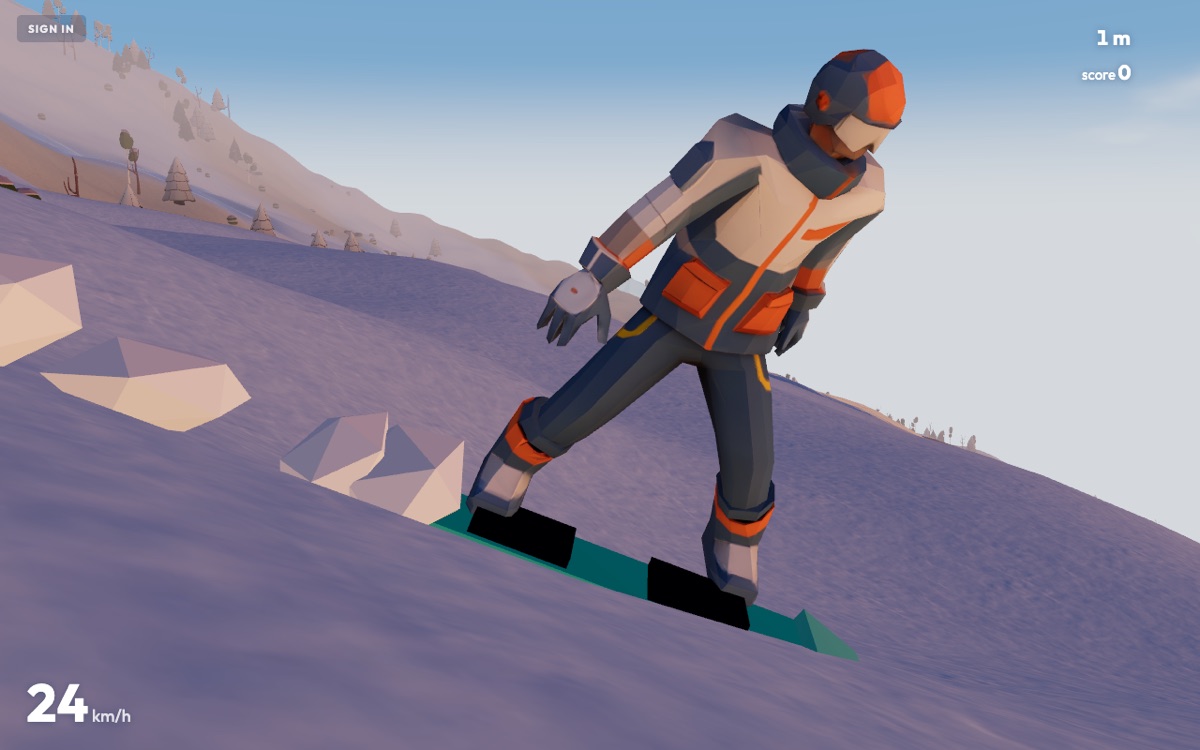
The snow under the board is never just snow. Every point on the mountain carries two weights, ice and powder, laid out by two independent noise fields; where neither is strong you are on hardpack, which is the baseline everything else is measured against. Ice wins where the bands overlap — a frozen patch cannot also be bottomless fluff — so the two never blend into a third thing.
You can see all three. Ice is glossy: it reflects the sky, which is what makes it readable in motion long before you reach it, and it tints toward a dark steel blue. Powder is warm and lumpy — pillowed with soft relief, because colour alone flattens out under the lighting. Hardpack is the bright, textured white in between.
What ice does
- Grip drops by two thirds. The carve force that bends your line is cut to 32% of normal on full ice. You do not turn; you drift, wide, and the board slides sideways across the fall line while you hold the edge.
- It is fast. Sliding friction falls to 30%, so ice carries speed a hardpack traverse would bleed.
- Stopping takes room. A hockey stop's edge holds about two thirds as hard on ice, so the stop turns into a long slide, roughly twice the distance. Plan it before the patch.
- It throws a skid. Steering on ice produces visible side-slip — the powder spray you see is the edge letting go.
- Landings get no help. Nothing softens a landing on ice.
The tactical answer is line choice: cross ice straight, carry the speed, and do the turning either side of it.
What powder does
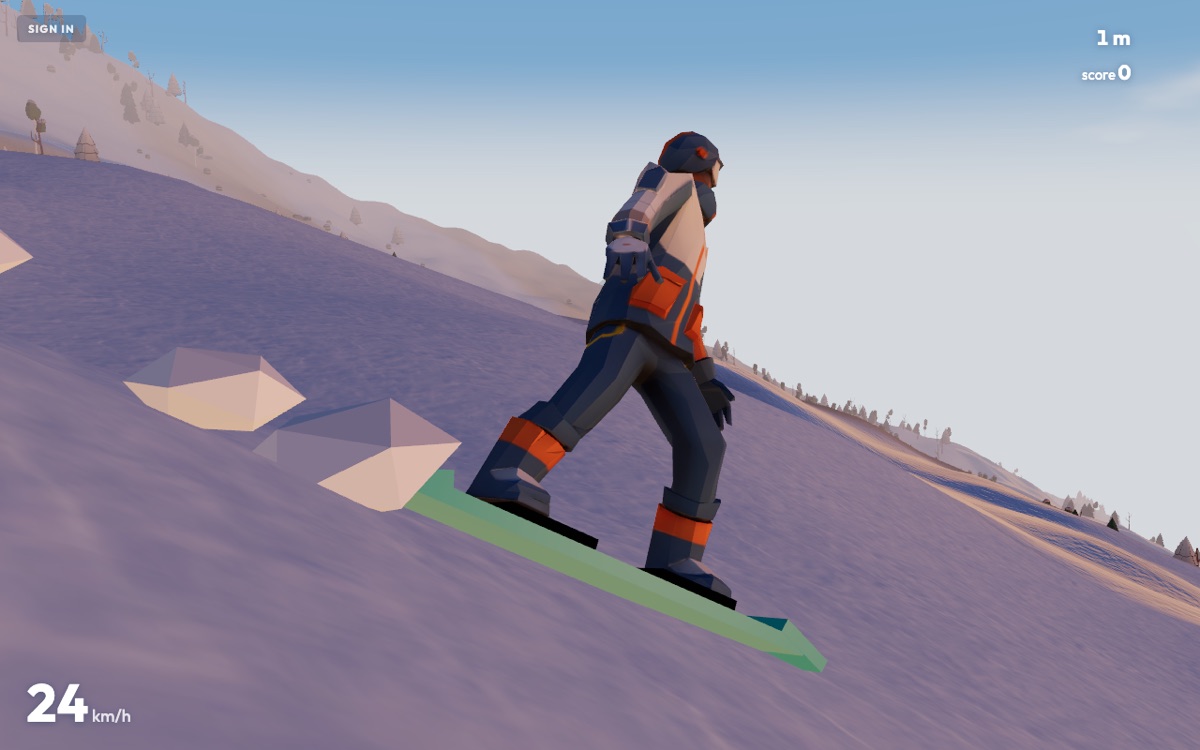
- It ploughs. Aerodynamic drag is up 90% and there is an extra 1.7 m/s² of resistance on top, so powder is slow — a tucked run through a deep field is a full gear down.
- It throws a wake. The board pushes a bow wave of snow that reads from the chase camera.
- Landings are kinder. Impact is reduced by 45% and every landing window is widened by up to 17°. A rotation that would have been a wipeout on hardpack can be a sketchy landing in deep powder, and a sketchy one can come up clean.
Powder is where you throw the big rotation. It is not where you set a distance record.
Where they are
Both surfaces are laid out by the same deterministic noise as the terrain, so a patch is always in the same place — two riders in a race hit the identical ice at the identical metre. Powder fields are broad and slow-changing; ice patches are smaller and sharper-edged.
Ice grows with depth. The threshold that decides where a patch forms eases as the mountain deepens (see how the mountain is built): over a sample grid, ice covers about 29% of the ground near the top and about 49% six kilometres down. Powder does not scale — it is a feature of the mountain, not a punishment.
Nothing grows through ice, so frozen patches are open ground: the trees and rocks scatter around them, never on them. A big ice field is often the cleanest line through a tight section, if you can hold it.
Your first run starts in seconds
Free in your browser on a laptop, a phone or a gamepad. No download, no sign-up.
PLAY FREE