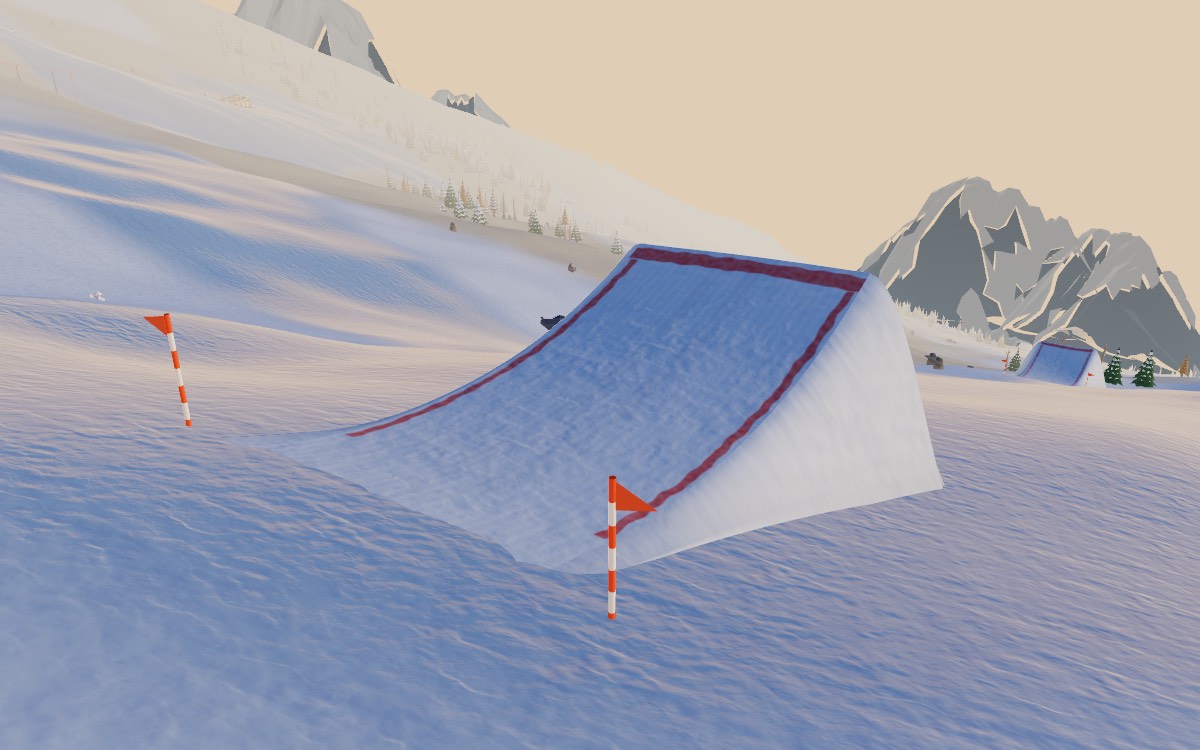
Kickers
A kicker is a built snow ramp: 9 m long, 5.5 m wide, rising to between 2.7 and 4.4 m at the lip, with the deck curving upward so the takeoff angle grows smoothly instead of hitting a step. The lip stands about 19° above the hill — enough air for a flip at speed without launching into orbit. The deck you see is exactly the surface the physics uses, sampled from the same curve.
There is one way onto a kicker: the entry, at the uphill end, where the deck lies flush with the snow. Its sides and its lip face are solid, and so are the broad snow shoulders a plain kicker's sides flare out into — about a third of a metre wider for every metre the wall stands. Come at one from the flank and you hit it the same as a tree, except over the first three metres or so of each side, where the deck is still low enough to be a kerb rather than a wall. Dropping off the side of the deck, or landing on a shoulder from the air, is fine. Riding straight up the middle is the whole technique.
A kicker launch is a deliberate one. Holding tuck across the lip counts as flip intent — the same key that is "just riding" on the snow becomes a frontflip off a kicker, which is how you start a rotation without a separate button. A held steer across the lip starts a spin the same way.
At cruising speed a kicker gives a single flip or a 360. For anything bigger you want speed in — a double flip from about 58 km/h, a triple from about 94 km/h — and a grab on the way up. The trick book has the tiers.
Rails
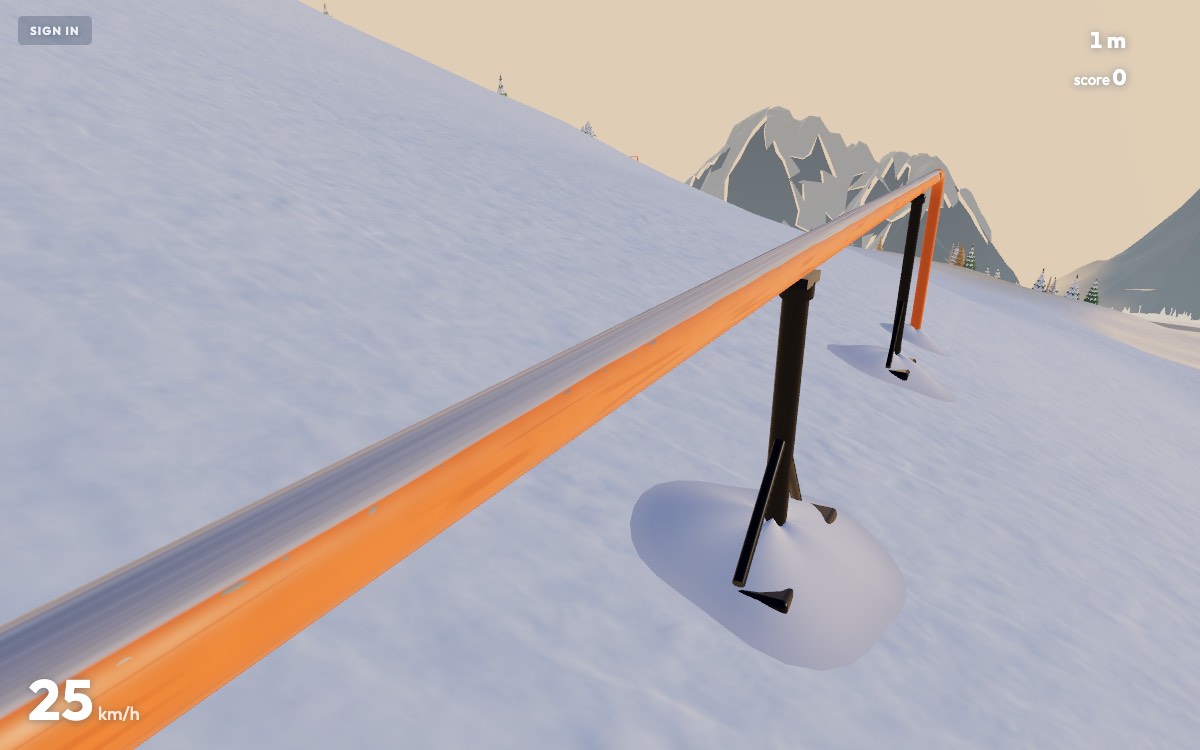
A rail is a rigid straight tube, 16 m long, sitting 42 cm above the snow at the entry and dropping at a fixed slope that is shallower than the hill, so it rises out of the ground as it goes. Where the hill rolls too much for that to work the rail is lifted until it clears everywhere; if that would put the entry out of reach, the spot is skipped and no rail is placed.
There are exactly two ways onto a rail, and nothing else:
- Ride into the entry. A short zone at the uphill end, head on: within about a board-length sideways, heading downhill, board at rail height. Riding on the snow beside a rail never pulls you onto it.
- Land on it from the air. Come down onto it anywhere along its length — falling, not rising past it, and within a board-length sideways.
On the rail, steer keeps you balanced; drift too far and you fall off the side. SPACE pops you off when you have had enough, and you cannot lock back onto a rail for about half a second after leaving one, so a pop is a commitment.
Boxes
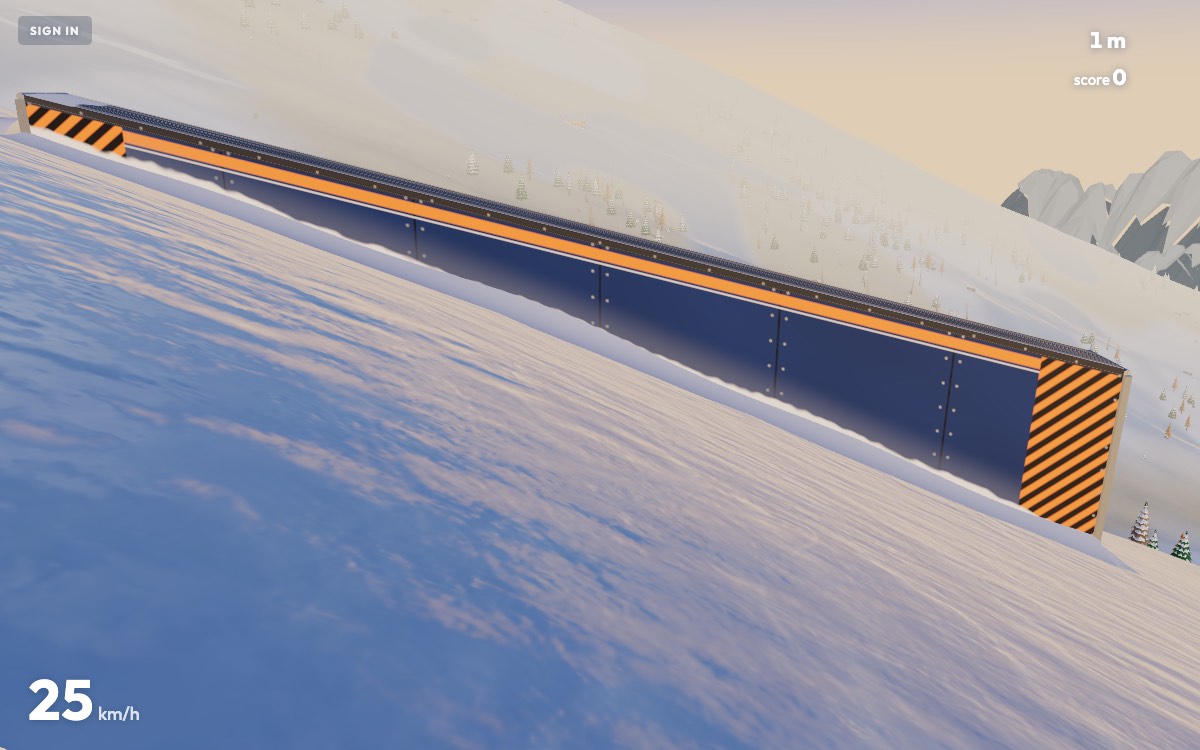
Some of the rail spots carry a box instead: a steel-framed slider 9 m long and 62 cm wide, planted in the snow with a graphite top between polished steel edges. It sits on the same line a rail would, its top at the height the board rides a rail at, and you get onto it the same two ways: ride into the entry, or land on it.
- Ride it anywhere across. A rail pulls you onto its centre line; a box lets you slide wherever you came on, and only eases you in off the edges.
- It is solid. A box stands on the snow, so its sides and both ends are walls. Ride into its side, or reach the striped entry face without locking on, and the run ends.
- It is shorter. Nine metres to a rail's sixteen, so it pays less per slide, and it scores as a BOXSLIDE.
How a grind pays
- 12 points per metre of rail, rounded to tens. The full 16 m is 190; a whole box, 9 m, is 110.
- +150 for spinning on. Arrive with a rotation and it pays on top.
- +25% for switch. Grinding off switch pays a quarter more, like a trick.
- A speed boost on the way off, the same way a landed trick returns speed.
A grind also wipes the slate for the repeat rule: a trick, a rail, and the same trick again pays in full, where trick-trick would pay half. For a run that wants points as well as distance, a rail between two kickers is the best line the mountain offers.
Your first run starts in seconds
Free in your browser on a laptop, a phone or a gamepad. No download, no sign-up.
PLAY FREE