Stance and riding
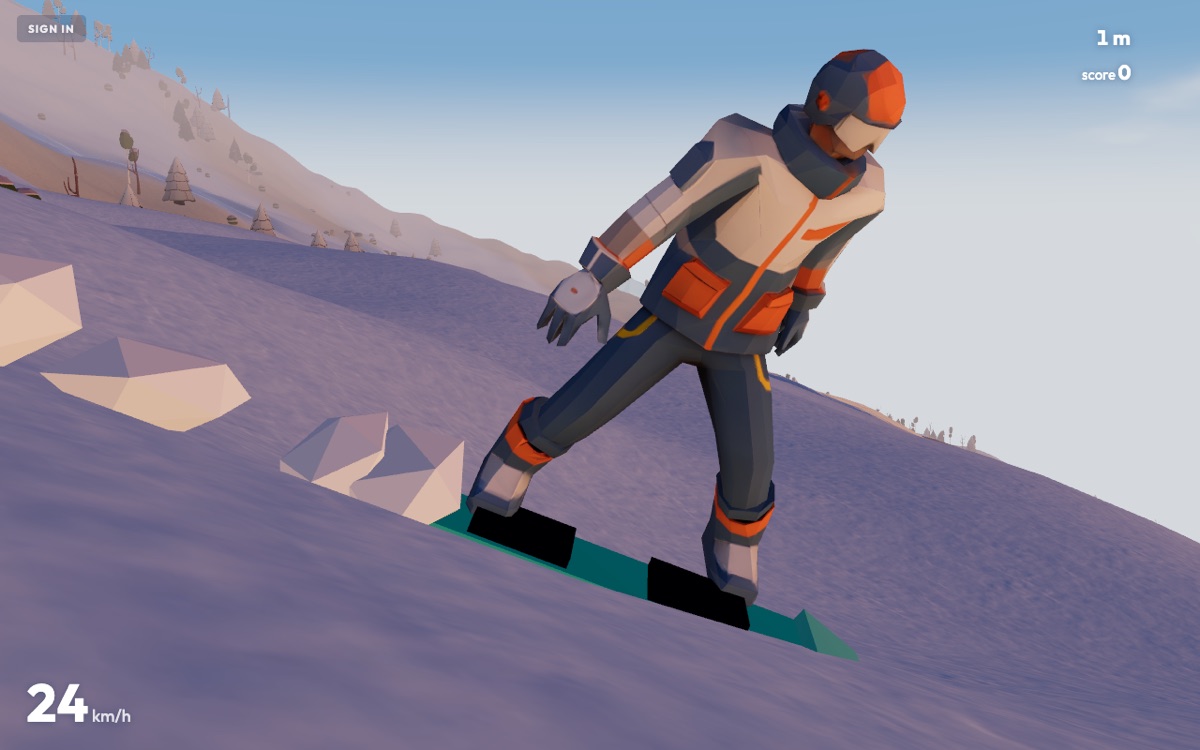
Regular / goofy. Which foot leads. Regular rides left foot forward, goofy right foot forward; neither is better, and most people find out which they are by being pushed from behind. In Powderline the rider is regular, and every camera and control is built around that stance.
Switch. Riding with the other foot forward — backwards, for your stance. Taking off switch is harder because you cannot see the lip as well, so it is worth more. The game names a trick that leaves the lip switch, and pays for it.
Fall line. The path a ball would roll down the slope: straight down, the fastest line. Everything a snowboarder does is measured against it — a traverse crosses it, a carve swings through it.
Edge. A snowboard has two: the toe-side edge under your toes, the heel-side edge under your heels. You turn by tilting the board onto one of them and letting it bite. A and D tilt the board onto an edge; the rider leans with it.
Carve. A turn made on the edge alone, the board bending into an arc and leaving a clean pencil line in the snow. The opposite is a skid, where the tail slides out sideways and scrubs speed. On hardpack the game carves; on ice grip drops to a third and the same input becomes a drift with a plume of spray — the snow page has the numbers.
Tuck. Crouching low with the arms in, to cut drag and go faster on a straight. W. It also arms the frontflip in the air.
Speed check. A quick skid to bleed speed before a feature you are arriving at too hot. A tap of S. On ice it barely bites — check before the patch, not on it.
Hockey stop. Stopping by swinging the board across the slope and setting an edge, so it scrapes instead of sliding and throws a sheet of snow ahead. A heelside stop sits back on the heels facing down the hill; a toeside stop leans into the hill on the toes. Hold S. It goes heelside, or toeside if you are already turning toward your chest, and holding S keeps you parked on the edge.
Line. The route you choose down a slope, feature to feature. Good riders talk about lines, not tricks. The mountain never repeats, so every run is a new line to read.
The snow
Powder (pow). Deep, fresh, untracked snow. Slow to ride through, glorious to fall into, and it swallows a landing that would hurt anywhere else. Powder zones cost you speed and forgive a sloppy landing, exactly that way.
Hardpack. Snow that has been groomed or ridden down firm. The surface most of a resort is made of, and the baseline everything else is compared to.
Ice (boilerplate). Refrozen, glazed, rock-hard. The board will not hold an edge and the brakes are gone. Glossy and blue-tinted so you can read it from a distance; cross it straight.
Moguls. A field of bumps built up by thousands of turns in the same spots. Skiers love them; snowboarders mostly do not. Mogul fields appear as you ride deeper into the mountain.
Whiteout. Cloud or blizzard thick enough that snow and sky merge and you cannot tell up from down. Weather fronts pass through the higher reaches of the mountain; the fog pools in the valleys.
The park
Kicker (booter). A built jump: an in-run, a lip that throws you, a flat deck on top and a sloped landing beyond. The game's kickers are timber decks with a snow lip; the park page explains why there is exactly one way onto one — from the front.
Lip. The very edge of the jump where you leave the snow. Pop off it and you get height; ride limply over it and you get a dead landing.
Knuckle. The rounded crest where the kicker's flat top rolls over into the landing slope. Coming up short and landing on it is the classic way to get hurt — no slope to absorb you.
Landing (transition). The downslope past the knuckle, built steep so that a rider coming down at speed meets snow going the same way. The further down it you land, the softer it feels.
Rail / box. Metal tubes and flat boxes you slide along on the base of the board. A 50-50 is straight along, a boardslide is sideways across. Every rail trick in the game scores as a GRIND, paid by the metres you hold it.
Ollie / pop. The jump itself: loading the tail and springing off it, with no ramp needed. SPACE. You can pop off a bump, a knuckle or flat snow; a kicker just gives you more of it.
In the air
Air. Time off the snow. Any time off the snow. Airtime above a second and a half earns a splash of snow on touchdown, and the longer you are up the more a trick pays.
Grab. Holding the board with a hand mid-air. Each grab has a name for where the hand goes: mute is the front hand on the toe edge between the bindings; indy the back hand there; method the front hand on the heel edge with the board pulled up behind you. Powderline has one grab, the mute — the front-hand reach that reads cleanly from the chase camera — and it stacks a bonus onto any rotation you hold it through.
Spin. Rotation around the vertical axis, named by degrees: 180, 360, 540, 720, 900, 1080. Frontside and backside say which way you turned — frontside opens your chest to the landing first, backside shows it your back. The game labels every spin FS or BS, and counts a rotation only once it is actually complete; a 360 that stops at 300 is a 180 with a bad landing.
Frontflip / backflip. Rotation around the sideways axis, head over heels forward or backward. Tuck and brake in the air (W and S) throw them; double and triple flips exist if the air does.
Cork. Off-axis: a flip whose axis is tilted, so the rider spins and inverts at once and the head dips below the board at some point in the rotation. The word covers a family — double cork is two inversions, triple cork three. Hold a flip and a spin together and the game integrates them into one rotation; two or more inversions with spin are named CORK and counted like flips.
Misty. A single forward-leaning off-axis flip with a spin — the entry-level cork, and the one most people learn first. One forward inversion plus any spin: MISTY 540, MISTY 720…
Rodeo. The backward version: one inverted rotation thrown over the back shoulder with a spin. One backward inversion plus spin: RODEO 540 and up.
Sending it. Committing fully to a jump or a line, no speed check, no half measures. The phrase you hear before either the best or the worst thing that happens all day.
Landing
Stomp. To land a trick decisively — board flat, weight centred, no wobble, no hand down. A PERFECT STOMP is a landing within a few degrees of flat; it pays a bonus and gives you a burst of speed out of the landing.
Clean. Landed and ridden away, with no drama. Most landings are clean; nobody cheers, nobody falls.
Sketchy. Ridden out, but only just: off-balance, a hand dragging, speed scrubbed. The trick counts, the style points do not. The landings page gives the exact angles that separate stomp, clean, sketchy and wipeout.
Wipeout / bail. Falling. A bail is choosing to abandon the trick before impact; a wipeout is the impact. The run ends and the rider tumbles; the distance you covered still counts on the leaderboard.
Steeze. Style plus ease — the quality of making something hard look relaxed. It is not on the scoreboard on a hill or in the game, and it is the only thing anyone remembers.
Words that are only Powderline's
Run. One descent, from drop-in to wipeout or exit. Distance and score are per run; the leaderboard keeps your best.
Quest. A daily or weekly task — so many flips, spins of 540 and up, metres of grind, kilometres ridden, runs finished or a race won — that pays coins once the server has confirmed the run.
The wheel. The prize wheel where coins become gear. The odds are published in the shop and are the same for everyone.
Closet. The fitting room: every piece of gear on a 3D mannequin, owned or not, so you can plan a fit before you spin.
Trail. The particle effect a board can leave — embers, frost, autumn leaves — purely cosmetic, like everything on the wheel.
Gates. In a 1v1 race, the checkpoints both riders must pass; first through the last gate wins.
Your first run starts in seconds
Free in your browser on a laptop, a phone or a gamepad. No download, no sign-up.
PLAY FREE