October 2026
A new course every race
- Every 1v1 race now has a course of its own. When the host starts, the game picks a fresh 1.5 km stretch of the mountain, anywhere in its first 30 km, and both riders get exactly the same one: every tree, kicker and ice patch in the same place.
- Wherever it lies, a course starts on easy snow and gets harder as you go, like a run from the top, so a course drawn deep down is not harder by luck.
- The start line and the finish are kept clear of trees, rocks, kickers and other riders. The finish gate stands on the course's own snow, never on a slope that has not loaded yet, and its beam always clears the snow under it.
- A rematch is a new course again.
Nothing left hanging in the sky
- Fixed: stretches of your track could hang in the air, sometimes a long way down the hill ahead of you, and the snow thrown off your carves, a gondola station or a tower could float in the sky when you looked back up the slope.
- Every 400 m the game quietly re-centres the world around you, and the track's copy on the graphics card missed that step, so the old track was left 400 m further down the mountain. It now moves with everything else.
- The mountain is also only kept for a short way behind you, and some things outlived the snow they lay on. Now everything that rests on the snow (your track, the thrown snow, the piles a stop leaves, the lifts and the finish gate) ends exactly where the snow does.
A new trailer on the front page
- The video behind the front page is now a montage of the game in action: hard carves throwing spray, a booster frontflip in slow motion beside the gondola, a rail slide in the park, a spin with a grab, and a hockey stop.
- It is much sharper. Every shot is filmed at 4K in the real game, and big or high-density screens get it in full 1080p.
- Phones get a portrait cut of their own, made from the middle of the frame, instead of a sliver of the wide one.
- Fixed: some browsers could not play the old video at all and showed only the still picture.
Deeper tracks in the snow
- Your board now cuts a real groove. Its floor sits below the snow, its walls rise to a lip, and the snow it pushes aside piles up in a berm on each side. One wall catches the sun and the other falls into shade, so you can read your line from the chase camera.
- How deep it goes depends on the snow: a trench through powder, a carved groove in packed snow, a thin frosty scratch on ice. The harder you carve, the deeper it cuts.
- The groove takes the colour of the snow it is cut into, so it no longer shows as a pale stripe across powder.
- Lumps thrown up by a carve now rest on the berms, and cosmetic trails lie in the groove, down its walls and over its berms.
A new look for the site, and a dev blog
- Every page of the website now has the same design as the front page: the night-blue ground, a shot of the game behind every title, and the same header and footer throughout.
- New: the dev blog, with status updates and longer write-ups of how new features are designed and built — the hockey stop, the radio, races, the leaderboard and the performance work of this week for a start.
APRÈS FM, a deep house station
- The radio has a second station. APRÈS FM plays deep house for after the last chair: four-to-the-floor kicks, off-beat hats, electric-piano stabs pumping under the kick, rolling sub bass, and a breakdown with a pad and a plucked lead before the drop.
- Like POWDERLINE FM it is written as it plays, so it never repeats. It keeps one tempo all session and mixes each record into the next over eight bars like a DJ, the kicks landing together.
- Press K to switch stations, or use the station button in SETTINGS. The station you pick follows your account to other devices.
POWDERLINE FM never goes quiet
- The lofi radio now blends one track into the next. The new track starts under the last bars of the old one and the two crossfade, so there is no more silence between tracks.
- The next track usually picks a key that sits well with the last, so the blend stays easy on the ear.
- Skipping a track with N blends too, instead of cutting out.
The hockey stop
- S is now a real snowboard stop. The board swings across the slope onto its edge, you sit back on your heels, and the edge scrapes you to a halt in a couple of seconds, throwing snow out ahead of you: the same spray a hard carve throws to the side.
- Already turning toward your chest when you press S? You stop on your toes instead, leaning into the hill.
- Hold S and you stay parked on the edge. Let go and you ride away, leaving a wide scraped swath and a ridge of the snow you pushed.
- It has its own sound, a pad rumbles with the edge, and your rival in a 1v1 race stops the same way, spray and all.
- On ice the edge barely holds, so stopping is a long slide, but now it does stop. Before, braking on steep ice did not.
Smoother frames, and rocks where they belong
- The woods are drawn far more efficiently. Only the trees, rocks and shrubs in front of you are drawn, and trees in the distance use a lighter version with the same outline. A typical frame now draws about 40% fewer triangles, and the slowest frames are about a fifth quicker.
- The carve track behind your board costs almost nothing to draw now.
- Fixed in browsers that run the game through WebGL on Apple devices, such as Safari before version 26: rocks, shrubs and the gondola cabins could be missing. They are back, and a rock you can hit is now always a rock you can see.
A fairer leaderboard, and safer races
- The leaderboard now checks every run on the server. A run only goes on the board once your ride has been logged, under your own rider name and with the score your ride actually earned.
- Rider names that read as web addresses are no longer accepted.
- 1v1 races ignore anything malformed the other player's game sends. The invite link now carries nothing but the race itself.
- A round of security fixes across the site and its servers.
A finish line worth crossing
The 1v1 race used to end between two red poles under a chequered strip. Now it ends under a proper race finish: an aluminium truss gantry with padded, ballasted feet bedded in the snow, a FINISH banner tied on under the beam, and feather flags beside the towers. On top of the beam, a timing board runs your race clock live and holds your time once you cross. Below it, a red dye line runs across the snow between two timing posts. The towers are solid, so ride between them.
Bumping into your rival
- In a 1v1 race the two riders now collide. Lean into each other and you both get shoved apart and lose a little speed. Cut hard across their line, or ram them from behind much faster, and you both go down, so ramming costs you too. Jump high enough and you fly clean over them.
- Nobody can be hit for a moment after dropping back in from a wipeout, and once one rider has crossed the finish the other can no longer be knocked about.
- Your rival is now drawn where they really are. Before, they showed a few metres behind their real position, because of the time their position took to reach you.
Closing things, and your rival's rider
- Every window in the game now closes with ESC or the × in its top-right corner. That covers settings, the shop, the closet, the leaderboard, your account, the race lobby, feedback, news and the legal pages. ESC closes only the window on top, and it no longer drops you into a run from the start screen.
- Your opponent in a 1v1 race used to be the old blocky snowboarder. Now they ride the same snowboarder as everyone else on the hill, in their own outfit and hat. Until their gear arrives they wear a blue jacket, and their name floats above them.
- The game no longer sits on the loading screen forever when your browser's graphics driver never answers. After ten seconds it starts on the more widely supported WebGL renderer instead.
A new main menu
The start screen no longer blurs the whole mountain behind a stack of grey buttons. The menu now sits in a column down the left, and the rest of the screen shows the slope and your rider. FREE RIDE is one big gold button, 1V1 RACE sits under it, and the shop, closet, leaderboard, account and settings are in a list below. Each entry has an icon and a line saying what it holds.
- On a phone the menu runs along the bottom of the screen, within reach of your thumb, and a tap on the snow drops you in.
- On short screens and in the smallest game-portal windows it squeezes down so everything fits without scrolling.
- The loading screen matches it now, over a picture from the game with snow drifting across. A gold bar with a percentage moves through three stages, waxing the board, packing the gear and carving the mountain, and tips on tricks and controls rotate underneath.
New sounds, and a lofi radio
The old sound effects were harsh, so all of them have been redone. Under the board there is now a soft glide on packed snow, with a crunch when the edge bites in a carve. The wind is a deep stereo rush that comes in gusts and grows with your speed, louder in the air. Rails scrape like steel instead of whistling, and landings hit with a low thump of snow. Coins are mellow plucks that climb a scale along a line instead of beeping. The prize wheel clicks like wood, and its fanfare rings like bells.
There is also a radio. POWDERLINE FM plays lofi while you ride, and every track is written on the spot: its own key, tempo, chords and melody, played on electric piano, bass and dusty drums with a little tape warble. Each one runs about two minutes and shows its name in the corner when it starts.
- L turns the radio on or off and N skips a track. Both are also under SETTINGS. Signed in, the radio setting follows you to other devices.
- Everything goes quiet while an ad plays and while the game is in a background tab.
- M still mutes everything at once.
A faster, harder mountain
Runs were lasting too long on snow that never asked much of you. The mountain now gets serious sooner and keeps pushing the deeper you go.
- Everything is a little quicker from the top: a tuck now settles near 95 km/h instead of 89, and the speed cap is up from 119 to 130 km/h.
- The snow runs faster the deeper you ride: about 105 km/h tucked four kilometres down and 110 past ten.
- The rough terrain, ice and tight trees now arrive by 4 km instead of 6, and the woods and boulders grow thicker down there than before.
- Landings forgive less deep down. The window for a clean or perfect stomp narrows, and the assist that eases a finished rotation level fades. What counts as a wipeout is unchanged.
- The first few hundred metres are as easy as ever. In a 1v1, both riders get exactly the same mountain.
Settings follow your account
Signed in, your settings now travel with you. Turn motion blur off on your laptop and it is off on your phone too, and the same goes for sound and the time of day.
- Render quality is kept separately for phones and tablets and for computers, so picking HIGH on a desktop never makes your phone run hot.
- The first time you sign in on a device, it takes the settings saved on your account. Anything your account has not saved yet is taken from that device.
- Signed out, settings stay on the device, as before.
Snow kickers
The plain kickers were timber wedges with brown planks and a plank wall at the back, which never looked like they belonged on a mountain. Now they are big jumps shaped out of snow, the way a park crew builds them. The deck is groomed, with the snowcat's corduroy still on it and two tracks worn up the middle, and a red dye line runs across the lip and down both edges.
- The sides fall away in broad snow shoulders that flare into the hill, and the back under the lip is a steep wall of packed snow.
- The shoulders are solid. Ride into one from the side and you hit it, the same as a kicker's wall. Dropping off the side of the deck, or coming down onto a shoulder from the air, is still fine.
- The ride is unchanged: the same deck, the same launch.
- Boosters keep their gold-chevron decks.
A new front page
The home page is new. It opens on a real run: the rider drops onto a gold-chevron booster beside a gondola line, holds a frontflip through the air and stomps it, filmed straight out of the game. Below it, a tour of what is on the hill, the six regions, the controls and the guides.
- It loads faster than the old page. On a slow phone connection the first screen is up in about half a second, and the video only starts once the page has finished loading.
- The video stays off on a data saver or a slow connection, and for anyone who has asked their device for reduced motion.
- Hovering or tapping a play button starts fetching the game, so it opens sooner after the click.
Gondola lifts
From about 900 m down, gondola lifts now run beside the run. Each line starts at a terminal cut into the slope. Its base is board-formed concrete, with a cabin garage and a service door in the tall downhill end. On top is a glass hall with a steel frame. The roof is thin, with a larch soffit and downlights, a band in the line's colour along the eaves, and snow and icicles on top. The end where the cabins come in is open, under a deep canopy. From there a row of tapered white towers carries the rope over the trees to a second terminal a kilometre or two below, and then there is open mountain until the next line. A clearing is cut through the woods under each one.
- Inside a terminal, the bullwheel the rope turns round sits under a cover in the line's colour, with its gearbox and motor on top. Rows of tyres run along the platforms over the cabins' grips, and an operator's booth stands between the two lanes.
- Riders get in through a glass door on the run side, up a short flight of steps. A lit sign pylon with a gondola on it stands by the open end.
- Each tower stands on a concrete footing and carries a crossarm in the line's colour, a train of rubber-lined sheaves under each rope, a railed walkway and a caged ladder.
- The rope is one steel loop. The cabins ride it down one side, swing round the bullwheel in the bottom terminal, come back up the other side and turn round again at the top.
- The towers and terminals are solid, like trees, and so are the terminals' steps and sign pylons. The ropes and cabins are overhead and never in your way.
- Where a line runs is part of the mountain, so both riders in a 1v1 see the same lifts, and the cabins keep the same clock.
Rail boxes
A new feature in the park: the rail box. Some of the spots that used to carry a rail now carry a box instead. It is a 9 m steel-framed slider planted in the snow, with a graphite top between polished steel edges, blue panels with an orange band, and hazard stripes at both ends. You get on it the same way as a rail, by riding into the striped entry or landing on it, and it slides like one.
- A rail pulls you onto its centre line. A box lets you slide wherever you came on across its top.
- A box is solid. Its sides and ends are walls, so riding into one ends the run, the same as a kicker's sides.
- It scores as a BOXSLIDE, at the same rate per metre as a rail.
- Kickers are where they were, and every rail that is still a rail is where it was. A few spots too rough for a 16 m rail are short enough for a box, so you will also find boxes where there was nothing before.
Rebuilt rails
The rails were a plain orange pipe on three black sticks. They are built like real park rails now. The orange powder coat is worn through to bare steel along the top, where boards slide, with paint chipped at the edges of the wear, grime down the sides and black collars at each end. The entry has a steel cap, and the exit kinks down into the snow instead of stopping in mid-air.
- Each upright carries the tube on a saddle, braced fore and aft down to a skid, and sits in a mound of packed snow.
- The grind is unchanged: the tube's centre line is the same one you ride, and the kink starts past the point where the grind ends.
New trees
The woods were four models from four different places that never matched: a near-black pine, a lollipop birch, a red dead tree and a bush stacked like a burger. Every tree and bush is new and made for the game. There are snow-laden spruces with green showing at the tips and underneath, a gold larch, a bare larch with snow along every bough, a weathered silver snag with a broken top, and low dwarf pines half-buried in drift.
- No two spruces are quite the same green, and the crowns sway slightly in the wind.
- The trees are shaded darker toward the trunk and under each tier, so a forest has depth instead of looking like flat cutouts.
- You hit a tree where you can see its branches: the collision shapes are measured from the new trees.
- The woods draw about a fifth fewer triangles than before, and four model files no longer download with the game.
Rebuilt boost kickers
The boost kickers looked homemade: blue and yellow stripes smeared across a timber wedge, a brown plank wall at the back and two traffic cones on sticks. Now they look like the park's proper engineered features. Gold chevrons stream up a graphite deck toward a lit lip, polished copings run along both edges, and a braced steel frame holds up the back. Every line is drawn sharp, however close you get.
- The chevrons move, flowing toward the lip, so you can tell a booster from a plain kicker long before you reach it.
- Two gold light pylons mark the way on, and LED strips run under the copings and across the lip.
- Snow drifts onto the entry, banks against the side walls and collects along the edges.
- The ride is unchanged: the deck is the same shape, and it launches and pays out exactly as before.
September 2026
A real snowboard
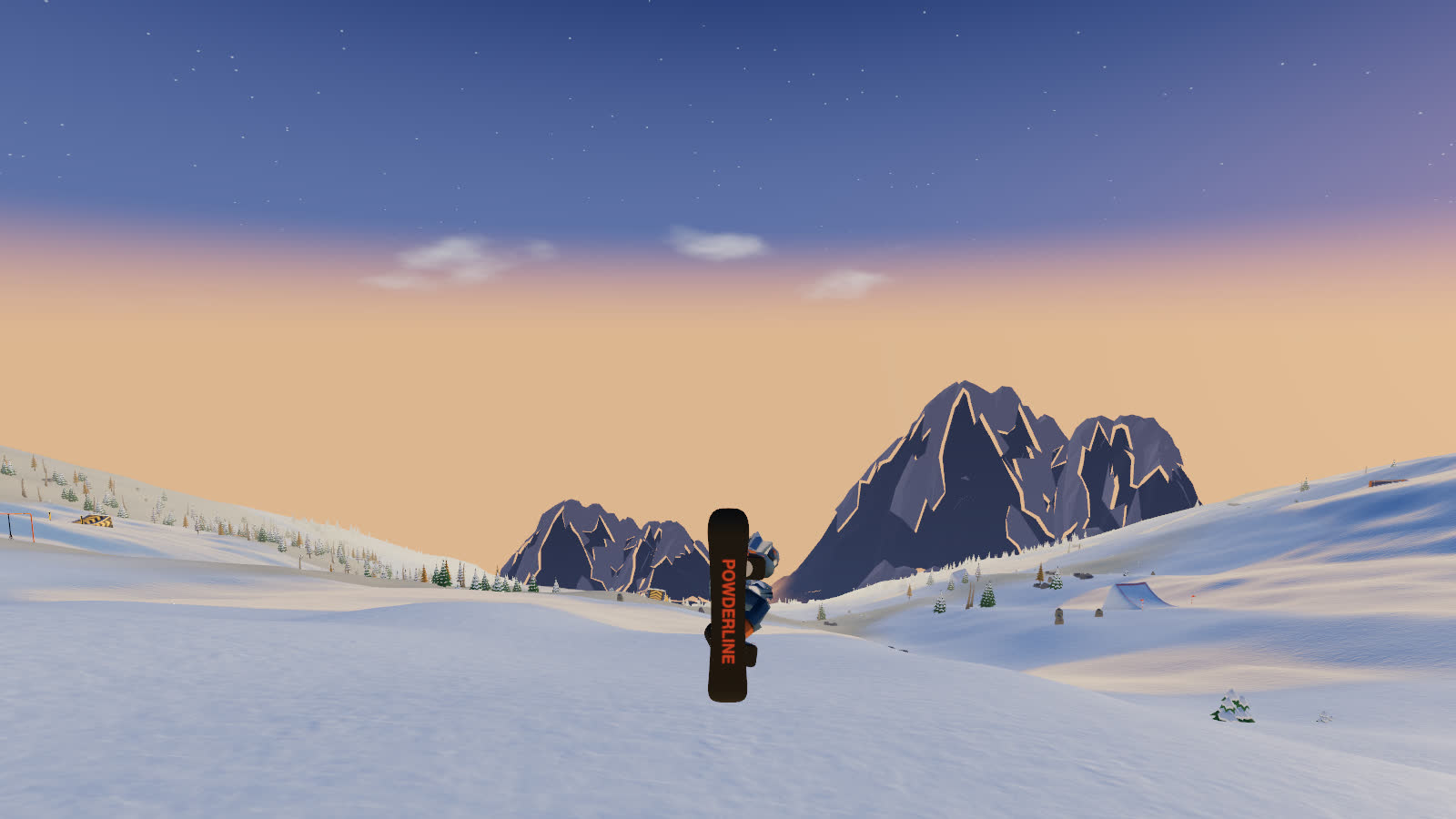
The board used to be a slab: a flat box with two plates on it. It is a proper snowboard now — camber underfoot, rocker at both tips, steel edges, a printed topsheet, POWDERLINE across the base, and strap bindings with highbacks. The bindings sit under your boots wherever the ride puts them, so a boot never stands beside its binding or through it, and the rider now stands centred across the board instead of hanging over the heel edge.
- Every deck design carries over onto the new topsheet.
- A jacket's matching board colour now repaints the board's cream field; its stripes and lettering stay.
- With no board or jacket picked, the board comes in the blue of the rider's default jacket and pants instead of the old plain teal, its orange stripes matching the orange trim.
- The riders standing about and hiking up the hill carry the new board too, and a wipeout throws it bindings and all.
- The whole board is about a fifth of a megabyte, and two unused mountain models and an unused tree no longer ship with the game.
A faster first load
The game's code and styles were leaving the server uncompressed. The web server was set up to compress them, but the way requests reached it switched that off for everything except the pages themselves. Now they are compressed too, and the first visit downloads about a third of what it did before. Nothing changes once the game is cached.
No ad script in the game
The game page no longer loads Google's ad script at all. The articles on this site still carry it, but nothing is ever placed over the ride itself. The only ads planned inside the game are optional ones: a short video you can choose to watch for a free spin of the prize wheel, and nothing if you would rather not.
Hikers
Riders are hiking up the hill now, boards on their backs. They walk a line up the fall line, stand a moment at the top, come back down, and go again; you will find them on the open slopes, the bowl and the piste, sometimes in pairs. They are as solid as anyone else on the mountain. Where a hiker is at any moment is a matter of the mountain's clock, not of your run, so both riders in a race pass the same hiker in the same place.
A smooth day on the mountain
The dynamic time of day was making the game stutter. Whenever the light changed, the sky was re-captured into the environment map that lights the snow — as it should be — but each capture handed the renderer a brand-new map, and the renderer answered by rebuilding the shaders of everything in the scene. That was a hitch every few tenths of a second through a preset switch and one every couple of seconds for about half of the dynamic day. The map is now refreshed in place, so a change of light costs a few GPU passes and nothing else.
The mountain in regions
The descent is no longer one long slope that slowly gets harder. It is cut into regions, each a few hundred metres to a kilometre long, each with its own character. DEEP WOODS closes the trees in tight. The BOULDER FIELD is rock after rock to weave through or hop. The SNOW PARK puts a kicker or a rail on nearly every stretch. The ALPINE BOWL is wide, bare and fast. On THE PISTE other riders stand about with their boards — the same rider model you wear, in outfits from the wardrobe — and they do not move out of your way. OPEN SLOPES is the mountain as it was, and it is always where a run starts. A banner names each region as you cross into it. Which region comes next is a property of the mountain, not of the run, so both riders in a race meet the same ones, and the kickers and rails you knew are where they were.
Races across networks
A 1v1 race between riders on different networks — one on home Wi-Fi, the other on mobile data, say — mostly never connected, while the same two devices on one Wi-Fi raced fine. When two routers will not talk to each other directly, the connection has to fall back to a relay, and the relay the game was leaning on had quietly gone away. The game now brings its own list of servers, fetched fresh for every lobby, relay included. When a link still cannot be made, the lobby says so — "no route between your networks" — instead of retrying into silence, and the browser console names the path the race took.
Drop in the moment you want to
After a wipeout, the way back onto the snow used to wait for the tumble and the card to finish arriving — a few seconds in which W did nothing. Now a fresh press of W, a tap on the pad or the jump button on a controller ends the run right there and puts you back on the hill the same frame. The ride is still logged and the score still posted on the way through. Holding W through the crash does not skip anything: only a press made after you went down counts, and a press in the first quarter second is taken as the jump you were mashing, not a decision.
Booster kickers
One kicker in three is now a booster. You will know it from uphill: gold chevrons on a deep-blue deck pointing at the lip, gold flags at the entry and a lit bar along the takeoff edge. Ride off it and the lip shoves you along the launch and lifts you a little higher — a bigger air with more speed to land, not a silly one; the landing windows are the same as on any kicker. Which kickers are boosters comes from the mountain itself, so both riders in a race see the same ones.
A day on the mountain
The time of day can now run by itself. The new DYNAMIC setting walks through dawn, midday, golden hour, dusk and night and round again, a full day every ten minutes, every change a slow blend rather than a switch — the sun, the sky, the fog, the light on the snow and the stars all move together. Each time of day holds for a while so it is recognisably itself before it eases into the next. A session opens at golden hour and never at night. Dynamic is the default if you have not picked a time; a time you chose yourself stays chosen, and T cycles through dynamic and the five fixed times as before.
Drag a screenshot into feedback
The feedback form takes screenshots by drag and drop now: drag an image anywhere onto the card and it lights up to say so. Pasting an image from the clipboard while the form is open works too. The picker button is still there, and the limit is still three per report.
Adding the game to your home screen, one tap where the phone allows it
The little card that asked you to add Powderline to your home screen has been rebuilt around how each phone and browser actually does it. On Android in Chrome or Edge, Add opens the system's own install dialog — one tap and it is on your home screen. Where a browser cannot do that, the card says so at once and shows the few taps it takes instead, with the real names of the buttons: the Share sheet on an iPhone, the menu under More in Firefox, and on an iPad or a Samsung phone whose browser cannot add it at all, a button that hands the page to Safari or Chrome, which can. It shows on the start screen and after a run, never during one, and it asks at most a few times, weeks apart. It is switched off in this release while it is being checked on real devices.
The hill never flattens
There were spots on the mountain where the snow levelled out or even tipped back uphill for a few metres — a trough between two moguls, the bottom of a roller — and a rider who stopped there could stand still and hop on the spot for air points, for as long as they liked. The relief is now stretched down the fall line: the big rollers run about five times longer along the hill than across it, the undulation three times, so nothing can tilt the slope back level any more. The height of the mountain is unchanged; the swells you see ahead are the same size, just longer. Every metre of the hill now drops, so a board at rest starts sliding on its own, and hopping in place only sends you down the slope faster.
- Moguls are a little lower than they were, because they are the one thing that could not be stretched without losing what they are for. The snow lets go of the board a bit sooner over a crest to make up for it, so at speed the bumps still pop you the way they did.
- Deep powder still ploughs hard enough to hold you on a gentle grade; the nudge that gets a stuck rider moving again takes care of that as before.
The website gets pictures, a glossary, a help page and a way to write in
Every guide page now shows the game as it actually renders — the kicker from the front, a carve throwing chunks off the edge, the splash of a long landing, the wipeout screen, a loadout worn on the hill — each frame taken from the game in the browser, not mocked up. Four new pages: a snowboarding glossary that explains what cork, misty, rodeo, knuckle, stomp and sketchy mean on a real hill and what they mean here; a help page for the problems riders write in about most (races that will not connect, frame rate, controllers, sound, sign-in, lost progress); a credits page naming every third-party asset and its licence, which the CC BY models were owed; and a contact page. Mistyped addresses now get a real "not found" page instead of a copy of the home page.
The privacy policy gains a section on advertising: the website's pages carry Google AdSense, and it says exactly what that means, what is asked of you in the EEA, and how to change your mind. The game itself shows no ads during a run.
The wardrobe, gone through one item at a time
Every cosmetic was put on the rider and looked at, and a lot of them were not what their name said. The worst was the jackets: the recolour only ever touched the sleeves, so twenty-seven tops were the same cream jacket with different arms. The body now takes the colour and the sleeves the accent, the orange zip and pockets can take a trim colour of their own, and the whole thing finally looks like a jacket in the colour you picked. Zebra Pants have stripes, Camo Pants have camo, Carbon Pants have a weave — patterns are painted into the fabric rather than promised by the label. Every hat was built for a head that is not the one the rider has: they all sat a nose too far forward and a finger too low, brims floated over the helmet, and the campfire burned above an open bowl where the helmet dome had been cut away. Hats now sit on the head as it is measured, a hat that replaces the dome closes it in the helmet's own colour, and the ones that perch on top — the cone, the party hat, the campfire — keep the helmet under them. The cowboy hat has a crown, the viking horns point outward instead of through the skull, the antlers are antlers, the pirate's tricorn is three brims and not a dome with sticks. Decks now take light from the sky the way the snow does, so they read as lacquered boards instead of dark strips. And the particle trails, which had quietly stopped drawing after the engine change and left only their ribbon on the snow, are back.
Then twenty-five new pieces: plaid, tiger, polka-dot, pinstripe, checkered-flag and snow-camo tops; plaid, tiger, checkerboard and snow camo pants; a Santa hat, party hat, bunny ears, flower crown and chef's toque; wood grain, rising sun, pixel hearts, topo map, snowflake and synth sunset decks; and embers, autumn leaves, frost and toxic trails. The wardrobe is 95 items.
Nine guides
The how-to-play page was one long scroll doing nine jobs. It is now an overview, and each system has its own page with the actual numbers the game runs on: the trick book and its arithmetic, the four landing bands, what ice and powder do, how the mountain is built and what deepens, kickers and rails, how a race works without a server, every control and setting, gear, the wheel and quests, and what it is all made of. Nothing in them is rounded off — if a page says a flip is credited within 57 degrees, that is the number in the code.
Signing up, and who gets to be on the board
Start typing into SIGN IN, realise you have no account yet, and the address and password you already typed now come with you to CREATE ACCOUNT — and back again if you switch the other way. It only ever fills a box you have left empty, so nothing you have typed gets overwritten, and the cursor lands on whatever is still missing.
Rider names are also checked now, everywhere one can be set: at signup, when you rename yourself, and on the guest name the leaderboard posts under. The check sees through the usual dodges — spacing a word out, swapping digits for letters, padding the letters, accents — and it runs in the database as well as in the page, because a public leaderboard cannot be guarded from the browser alone. Ordinary names are not the target: Scunthorpe, Cockburn, Hancock and Analiese all sit on the board unbothered — and if the check ever gets a real name wrong, an admin can set it by hand, so nobody is stuck with a name they did not choose.
A new engine under the snow
Powderline now renders through WebGPU where your browser has it, and falls back to WebGL2 where it does not — the same mountain either way, with the modern path spending far less of your CPU on telling the graphics card what to draw. Every surface in the game was rewritten as a shader graph to make that possible, which is why the sky, the snow and the far ranges look the same as they did: that was the goal, checked pixel by pixel against the old renderer.
On top of it, three things you can see. Valley fog that knows which way is down: the air pools in the bowls below you and thins on the ridges, so dropping into one now means riding down into the murk. A blizzard that thickens the deeper down the mountain you get, layered into that same air. And a speed blur that pulls in from the edges of the screen once the run is genuinely quick — off entirely below about 45 km/h, so it reads as speed rather than as a smeared lens. All three are skipped on the low quality setting, and the blur has its own MOTION BLUR switch in SETTINGS: turning it off keeps the fog and the weather, because a screen that smears is something people switch off for comfort, not for frame rate.
Kickers have sides, landings have weight
A kicker's deck is a shaped surface, and until now nothing stopped you riding at the side of one, climbing its wall like a bank and launching off a lip you never rode up. The sides and the lip face are now solid: come at a kicker from the flank and you hit it, the same as a tree. The entry is the way on, and the first metres of the sides — where the deck still lies flush with the snow — stay rideable. And a landing off a real air, more than a second and a half of it, now blows the snow out from under the board: the same powder the carve trail throws, thrown in a ring and left lying where it falls, bigger the longer you were up. Hops off rollers stay clean, so the splash means something when it comes.
One grab, and a carve that stands up
The rider used to fold a long way back through a turn — the body angulation was driven nearly twice as hard as the edge it was supposed to follow, and a heelside carve came out as a recline. The board still banks the full angle it actually pulls; the upper body now rides well inside it, so the turn reads off the edge rather than off a leaning torso. The heel-edge METHOD is gone with it: reaching behind the front leg arched the whole spine and looked wrong from the chase camera. Every grab is now the MUTE — leading hand on the toe edge between the bindings — straight, spun or flipped.
A first run that teaches itself
Your first ride now comes with a coach instead of a line of tiny text: one keycap and one word at a time — carve, hold for speed, jump, flip in the air, grab — each prompt clearing the moment you do the thing, with a SKIP button if you already know. Once through it, the HUD stays clean for good — the controls reference lives in SETTINGS. The wipeout card has real DROP IN AGAIN and MENU buttons for mouse and touch players (W and JUMP still work), and a pause button sits in the corner on every device. The main menu fits a short window without cropping the title, and leaving the tab mid-run pauses the ride instead of ending it.
The same mountain at 60 Hz and 240 Hz
Rollers used to unweight the board more readily on a high-refresh monitor than on a 60 Hz one — the check that decides when the snow lets go compared a per-step gap with a per-step threshold, and the two did not scale alike. It now reads the slope's actual curvature over a fixed half metre behind the board, and a landing touches down where the arc meets the snow rather than a whole step past it. A scripted ride over a row of kickers now ends within two percent of the same spot from 30 Hz to 240 Hz. On weaker machines the game also lowers its render resolution a notch when the frame rate sags and restores it when it recovers, and the rider's texture went from 2 MB to a sixth of that, so the first load is quicker. Old Safari gets its frosted menus back, and the sound has a limiter so a stacked thump and boost no longer crackle.
No more glowing track
The carve track used to trail the board as a bright white streak in low sun. Its faces were wound upside down, so the double-sided strip was lit from below by the horizon glow instead of by the sky. Wound the right way, and wearing the snow's own texture, the groove now shows through its shape and shading only.
The rider moves like a rider
A pass over how the snowboarder moves, animates and is controlled. Steering now rolls the board onto its edge over a tenth of a second instead of snapping to full lock, and the body leans as hard as the carve actually pulls — laid over at speed, barely tilted at a crawl — with the head turned into the turn. A jump is a push: the legs drive straight off the snow (and off a kicker lip) before the knees draw up. Flips pull the rider into a tight tuck, spins wind the shoulders ahead of the board and unwind as they brake, and the eyes drop to spot the landing. Grabs are now two, both with the leading hand: a laid-out METHOD flying straight and a MUTE through any rotation — each an authored pose with the mitten on the edge it names, and each named on the popup in place of plain GRAB. Limbs settle at their own pace, so a pose change reads as a body rather than a switch. The camera stays calm: it opens up a little on a real air and dips slightly with your knees on a landing. And a controller works out of the box: left stick or d-pad to carve, RT/LT to tuck and brake, A to jump, X or RB for speed and grabs, Start to pause — and it rumbles with landings, boosts and wipeouts.
The trick book
Tricks are now read off a fixed book instead of rounded to the nearest name. A flip is credited per full turn and a spin per 180°, and a step counts only once you have come within the landing window of it — 250° of yaw is a 180 landed long, never a 360, and half a backflip is no backflip. Every count has a name: QUAD and QUINT join DOUBLE and TRIPLE (a quad used to read TRIPLE), corks carry their FS or BS, and spins run on past 1080. Landings are tighter to match — clean inside 34°, sketchy to 57°, a wipeout beyond — and the stomp assist only settles a rotation you finished, where it used to level anything inside 70°. Rotation spools up and brakes faster, and a grab now rotates you half as fast again: it is the key to the multi-flip tiers, and a quad backflip finally fits a top-speed kicker air. The guide has the full book and the numbers.
Phone fixes
- The touch pad and buttons now leave the screen with the rider: on the wipeout card only the pause button remains, and a tap anywhere drops back in.
- On a phone held sideways the wipeout card was taller than the screen — the title and the SHARE and TAP TO DROP IN lines were cut off and could not be reached. It is tighter now and scrolls when it must.
- Speed, distance and the sign-in button keep clear of the notch and the home indicator.
- Installed on an iPhone home screen, the game stopped short of the bottom edge and left a pale stripe there. It fills the screen.
Powderline on other sites
The game can now be embedded on games portals — CrazyGames, itch.io, Game Jolt — straight from this domain, and it knows when it is. Embedded, it runs as a guest build: free ride, the closet, the leaderboards and share cards, and nothing a portal does not allow inside its frame — accounts, the shop, ads or links leading away. The full game, with quests, the shop and 1v1 races, stays here at powderlinegame.com, and where a portal allows it the guest build says so.
Share your run, and ride from your home screen
SHARE THIS RUN on the wipeout card turns the run you just ended into a card — the crash-cam view with your distance, score and top speed on it — and hands it to your phone's share sheet (or copies the link and downloads the image on desktop). Signed-in riders get a proper link: paste it in Discord, iMessage, WhatsApp or Reddit and it unfurls into the card, and anyone who taps it lands on the mountain with your invite code, so every share is also a referral. On phones, the game now offers to add itself to your home screen after your first run — full screen, no browser bars. Say no once and it never asks again.
Tracks in the snow
The board now leaves a real groove behind it. The old carve ribbon was a faint highlight that faded within a couple of seconds; the new track is a three-dimensional trough — berms of pushed-aside snow on both sides, a lit wall on the sun side and a shaded one opposite — and it stays on the mountain for about 400 metres behind you before it fades. It breaks cleanly under every jump, and hard carves throw clumps of snow that pile up along the lip and stay where they land — plus fist-sized lumps flung sideways off the slipping edge, arcing out and gone when they hit the snow.
- Deleting a feedback report with screenshots failed on the live site with a storage error. Fixed.
- The ambient snowfall is gone, and so is the carve and landing spray — the slope reads cleaner, and weaker machines get the frames back. Rail sparks stay.
- Terms of service and privacy policy, version 3: they now describe Google sign-in, feedback screenshots, transactional e-mail delivery and the website's cookie-less statistics, add a health & safety notice and clearer fair-play rules, and drop a reference to the EU dispute platform that closed in 2025. They take effect for existing riders on 20 September 2026; new accounts accept them right away.
The flickering peaks, Google sign-in, better e-mails
A rider reported rocks in the distance flickering in and out — thank you, it was real. The far ring of the horizon range sat beyond the sky dome and fought it for the same pixels; the backdrop now paints in strict distance order and the camera's depth precision is five times finer, so the horizon holds still. That report earned the first 200-coin feedback bounty.
- Sign in with Google, next to the e-mail sign-in.
- Account e-mails now come from info@powderlinegame.com with a proper design, instead of a generic sender.
- Exiting to the menu mid-run left the wind blowing over the title screen. Silenced.
- Admins can now see the screenshots attached to feedback.
- This website grew up: a full how-to-play guide with the real scoring rules, quest tables and wheel odds, this updates page, an about & contact page, and the privacy policy and terms as proper pages instead of menus inside the game.
Feedback with screenshots
Bug reports and ideas can carry up to three screenshots. Pick them in the feedback box, they are resized on your device before upload, and the patrol sees them next to the report.
Feedback & bugs, and phones that actually work
- A FEEDBACK & BUGS entry in the menu footer: pick bug, idea or other, write it up, send. If your report leads to a fix, you get 200 coins.
- Touch controls: a floating steering pad on the left, JUMP and BOOST on the right. BOOST becomes GRAB in the air, and after a wipeout you tap anywhere to drop back in.
- The admin dashboard works on a phone.
August 2026
Lighter snowfall
The ambient snowfall was cut to about a third of its particle count. It reads as weather now, not a blizzard, and weaker machines get the frames back.
Dusk by default
The mountain now opens at dusk. Phones in portrait get a rotate prompt instead of a squashed slope, and the footer gained the Instagram link.
Season opening: new rider, fitting room, fresh horizon
The biggest update so far, announced in-game as MOUNTAIN NEWS.
- Off-axis tricks. Flips and spins now integrate together, so holding both carves out mistys, rodeos and double corks instead of two separate tricks.
- Graded landings. Perfect stomp, clean, sketchy or wipeout — and a speed payout that scales with how level you came down.
- A new hero mountain range on the horizon, with proper haze and snow-capped rock.
- Maintenance mode and announcements, so the patrol can close the mountain for work and tell everyone why.
- The admin tools grew detailed rider stats, plus the ability to grant and revoke cosmetics.
- Branded account e-mails and the groundwork for free wheel spins by watching an ad (not switched on yet).
Consent, best runs, and a self-hosted dev mountain
- Creating an account now asks you to read and accept the terms and privacy policy, and records which version you accepted.
- Best distance and best score are tracked on your profile and shown on the HUD.
- An admin panel for rider management and traffic statistics.
- Development moved to a self-hosted backend so testing never touches the real mountain.
Grabs, invites, streaks
- Grabs. Hold SHIFT in the air: the body pulls in, rotation speeds up, and the hold scores. Reach and weight distribution were tuned over the day.
- Terrain difficulty deepens more convincingly the further you ride; kickers and rails spawn a little more often.
- Referral program: invite a rider, both of you earn 200 coins.
- Rider names became unique, case-insensitively.
- An activity heatmap with a day streak on the account screen, with hover cards showing the day's full stats.
- Privacy compliance: private profiles, erasable leaderboard posts and one-click account deletion.
A logo
Powderline got its mark, used as the site icon and on Instagram.
Trick battle
A second race mode: no finish line, a clock instead, highest score when it runs out wins. Banked points survive a crash.
Powderline opens
First public build: the endless procedural mountain, carving, flips and spins, rail grinds, the prize wheel and closet, daily and weekly quests, rider accounts and leaderboards, and peer-to-peer 1v1 races. Sign-in was split from account creation the same day.
Your first run starts in seconds
Free in your browser on a laptop, a phone or a gamepad. No download, no sign-up.
PLAY FREE